Special offer. Handel: Cantatas and Sonatas
Jorge Juan Morata (tenor) & Lixsania Fernandez (viola da gamba)
Recondita Armonia Ensemble
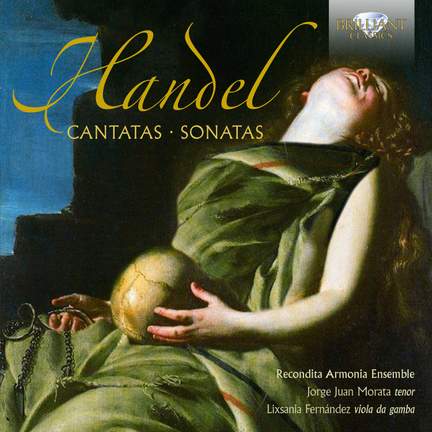
Special offer. Handel: Cantatas and Sonatas
Jorge Juan Morata (tenor) & Lixsania Fernandez (viola da gamba)
Recondita Armonia Ensemble
Purchase product
About
This attractive album focuses on the young and prolific Handel during his years of residence in Italy, the most celebrated product of which is his setting of Dixit dominus from 1707. However, at the invitation of various aristocratic patrons in Rome and Florence around this time, he also composed many secular cantatas which have only in recent years received their due attention on record; not least thanks to Brilliant Classics, who have published four volumes of Italian cantatas with the Contrasto Armonico ensemble (BC93999, BC94000, BC94230 and BC94257).
This album from another historically informed Italian ensemble is not a rival but complement to them. Ah, che pur troppo è vero (HWV 77) was composed in Florence around 1707, and Care selve, aure grate (HWV 88) was written in Rome between 1707 and 1708. A final contribution to the genre, Dolc' è pur d'amor l'affanno (HWV 109b), was produced in London around 1718, by which time Handel was the toast of London. All the cantatas tell tales of love found and lost, with pining arias and sprightly recitative, already distinguished by the powerful match of melody to mood and superb understanding of the voice that would make Handel the opera composer of his age.
The cantatas are interleaved with two instrumental sonatas. The obbligato instrument in mind was originally an oboe (HWV 363a) and recorder (HWV 367a) but their parts are taken here by a viola da gamba. HWV 367 is the most sophisticated of Handel’s chamber sonatas and has long been a favourite of flautists, but is here lent an unusual, mellower character by the lower string instrument. HWV 363 is also in four movements, more dance‐like in character, and concluding with an irrepressibly lively Bourrée.
Contents and tracklist
- Jorge Juan Morata (soloist), Lixsania Fernández (soloist)
- Recondita Armonia Ensemble
- Recondita Armonia Ensemble
- Jorge Juan Morata (soloist), Lixsania Fernández (soloist)
- Recondita Armonia Ensemble
- Recondita Armonia Ensemble
- Jorge Juan Morata (soloist), Lixsania Fernández (soloist)
- Recondita Armonia Ensemble