Special offer. Emily Pailthorpe: Better Angels
Emily Pailthorpe (oboe)
BBC Symohony Orchestra & BBCSO Soloists, Martyn Brabbins
Brabbins nurtures the orchestra’s proliferating counter-melodies, and the recording renders them all clearly, though without ever making the BBC SO sound like the ‘small orchestra’ Strauss specified
Special offer. Emily Pailthorpe: Better Angels
Emily Pailthorpe (oboe)
BBC Symohony Orchestra & BBCSO Soloists, Martyn Brabbins
Purchase product
Brabbins nurtures the orchestra’s proliferating counter-melodies, and the recording renders them all clearly, though without ever making the BBC SO sound like the ‘small orchestra’ Strauss specified
About
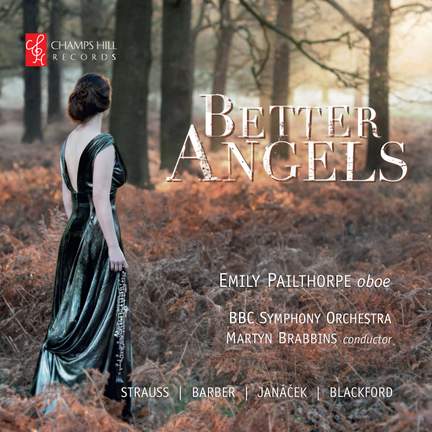
This new recording by virtuoso Emily Pailthorpe brings together one of the most famous concertos for oboe – by Richard Strauss – with a new work The Better Angels of Our Nature by Richard Blackford, both recorded with the BBC Symphony Orchestra under Martyn Brabbins.
Richard Blackford is known not only for his music for theatre, film and television, but also eloquent and lyrical works for the concert hall. The Better Angels of Our Nature was commissioned by, and premiered by Emily Pailthorpe in 2012. It takes its title from an inspirational plea for reconciliation by Abraham Lincoln in his first inaugural address in 1861. It is divided into two continuous movements.
Richard Strauss’s Concerto for oboe in D major is a late work, written in 1945. Approached by John de Lancie, a corporal in the US army but in civilian life a professional oboist, Strauss originally rejected the idea of a concerto for the instrument, but the idea took seed. Sadly, through a series of complications, de Lancie never premiered the work, but it has become a mainstay of the repertoire.
Two pieces beloved of wind players form the central sections of the disc: Barber’s Summer Music for quintet, and Janáček’s Mládí for sextet, for which Pailthorpe is joined by colleagues from London Conchord Ensemble, of which she is a founder member. Commissioned in 1953, Summer Music is a single movement, showcasing each instrument of the quintet: flute, oboe, clarinet, bassoon, and French horn.
Mládí (or ‘Youth’) by Janáček, written in 1924 when the composer was 70, adds a bass clarinet to the traditional wind quintet line-up in a piece which melds together reminiscences of Moravian folk-tunes with Janáček’s sensitivity to the lilt of human speech patterns.
With her unique vocal sound and compelling musicianship, oboist Emily Pailthorpe has won a large following amongst fellow musicians and concertgoers worldwide. Emily’s career was launched at the age of 17 when she became the youngest artist ever to win the Fernand Gillet International Oboe Competition. Playing the Vaughan Williams Concerto, she was hailed by the judges as “the Jacqueline du Pré of the oboe”. Emily went on to make her acclaimed concerto debut in 2003, playing the Strauss Concerto with the Philharmonia Orchestra, and gave her Wigmore Hall recital debut in the same year. As part of the BBC celebrations to mark International Women’s Day 2016, Emily was invited to perform Thea Musgrave’s virtuosic Concerto for Oboe and Orchestra Helios with the BBCSO, broadcast live on BBC Radio 3.
Contents and tracklist
- Emily Pailthorpe
- BBC Symphony Orchrestra
- Martyn Brabbins
- Emily Pailthorpe
- BBC Symphony Orchrestra
- Martyn Brabbins
- Emily Pailthorpe, Daniel Pailthorpe, Richard Hosford, Julie Price, Nicholas Korth
- Emily Pailthorpe, Daniel Pailthorpe, Richard Hosford, Julie Price, Nicholas Korth, James Burke
- Emily Pailthorpe
- BBC Symphony Orchrestra
- Martyn Brabbins
Awards and reviews
 November 2016
Brabbins nurtures the orchestra’s proliferating counter-melodies, and the recording renders them all clearly, though without ever making the BBC SO sound like the ‘small orchestra’ Strauss specified
 31st January 2017
A welcome opportunity to enjoy rarely heard works for oboe and ensemble played with assurance, poise and innate musical intelligence.
 4th August 2016
Pailthorpe has put together an intriguing programme from the limited repertoire available. She begins with a lusciously long-breathed account of Strauss’s late concerto, then makes lyrical work of Samuel Barber’s valedictory Canzonetta.