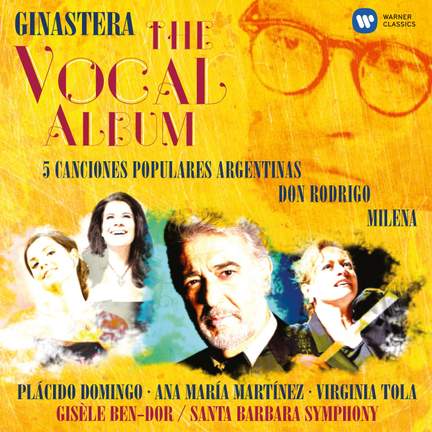
Ginastera: The Vocal Album
Placido Domingo (tenor), Ana Maria Martinez (soprano), Virginia Tola (soprano)
Santa Barbara Symphony Orchestra, Gisele Ben-Dor
Awards:
-
Opera, June 2016, Recording of the Month

It’s astonishing how fresh Domingo still sounds…all the more impressive, considering that Ginastera’s score is comparable to Berg’s Lulu both stylistically and in its extreme technical demands…[Virginia...
Ginastera: The Vocal Album
Placido Domingo (tenor), Ana Maria Martinez (soprano), Virginia Tola (soprano)
Santa Barbara Symphony Orchestra, Gisele Ben-Dor
Purchase product
Awards:
-
Opera, June 2016, Recording of the Month
It’s astonishing how fresh Domingo still sounds…all the more impressive, considering that Ginastera’s score is comparable to Berg’s Lulu both stylistically and in its extreme technical demands…[Virginia...
About
It was not in an opera by Verdi or Puccini that Plácido Domingo made his major and decisive breakthrough in New York, in 1966 at the age of 25. It was in fact in a work by the Argentinian composer Alberto Ginastera (1916-1983), whose centenary is celebrated with this album of operatic excerpts and concert music for voice.
The performers on Ginastera – The Vocal Album are Domingo, the sopranos Ana-Maria Martínez and Virginia Tola (both past prizewinners in Domingo’s Operalia competition) and California’s Santa Barbara Symphony under its conductor laureate, Gisèle Ben-Dor. She is a native of Uruguay, one of Argentina’s closest neighbours, and a notable champion of Latin American music. In 2004 – in collaboration with Ginastera’s daughter Georgina – she staged the Tango and Malambo Festival in Santa Barbara.
In his autobiographical book My First Forty Years, Domingo – whose 75th birthday falls in January 2016 – recounts his experience with Ginastera’s first opera. “In New York I embarked on the double adventure of singing the title role in the North American premiere of Ginastera’s Don Rodrigo and, with it, the opening of the City Opera’s new home at the New York State Theater in Lincoln Center … The opening night – 22nd February 1966 – was a special occasion and therefore received considerable attention … For the public it was an exciting evening: they had not seen a contemporary opera of that stature in a long time. For a young Spaniard to be able to sing, on such an occasion, the role of a Spanish king, and in Spanish, was an unforgettable experience. There was much praise for the work, for the production and, fortunately, for my singing. I did not realize at that moment what it all meant for my future.”
Don Rodrigo is set in Spain in the 8th century. The title character, also known historically as Roderic, is the last of the country’s Visigoth kings, and the opera – which, musically and structurally speaking, takes Alban Berg’s masterpiece Wozzeck as its model – recounts a gripping tale of pride, passion and downfall. As the New York Times wrote after its world premiere in Buenos Aires in 1964: “The music is powerful, direct, compelling — at times almost overwhelming in its dynamic intensity.”
If Don Rodrigo can be classified musically as a piece of atonal expressionism, the Cinco Canciones Populares Argentinas, dating from some 20 years earlier and written as a response to political turmoil in Argentina, draw directly on the country’s folk music and are full of Latin colours and inflections. Ana-Maria Martínez, born in Puerto Rico, lends her rich and mellow vocal texture to their evocative lines.
The Old World is the focus of the dramatic cantata Milena, composed in 1971 and performed with characteristic intensity by Virginia Tola, who is from Argentina. The cantata’s text is a Spanish translation of letters that Frank Kafka wrote (in German) to Milena Jesenská, who was the first person to translate his work into Czech. Kafka and Jesenská – who was married – met only twice, but, in the course of 1919 and 1920, they conducted an intense relationship via correspondence. The cantata, which makes use of both sung and spoken text, is composed in an uncompromisingly modern style, but includes a haunting musical quotation from ‘Der Leiermann’, the concluding song of Schubert’s gloomy song cycle Winterreise.
Contents and tracklist
- Ana Maria Martinez (soprano)
- Santa Barbara Symphony
- Gisèle Ben-Dor
- Virginia Tola (soprano), Plácido Domingo (tenor)
- Santa Barbara Symphony
- Gisèle Ben-Dor
- Virginia Tola (soprano), Rafael Sardina (baritone), Plácido Domingo (tenor)
- Santa Barbara Symphony
- Gisèle Ben-Dor
- Virginia Tola (soprano), Geoffrey Rutkowski (cello)
- Santa Barbara Symphony
- Gisèle Ben-Dor
Awards and reviews
-
OperaJune 2016Recording of the Month
 June 2016
It’s astonishing how fresh Domingo still sounds…all the more impressive, considering that Ginastera’s score is comparable to Berg’s Lulu both stylistically and in its extreme technical demands…[Virginia Tola] shows her emotional mettle in Milena…Ana María Martínez sings [popular Argentinian songs] with gusto and an appropriate feeling of bittersweet nostalgia.
 9th March 2016
The performances have real authority...The demanding part of Florinda, Rodrigo’s lover, is taken by Virginia Tola, though she is even more impressive threading her silvery soprano through the textures of Milena...You hardly notice the joins, though, and in any case much of the music is such a treat that it doesn’t matter at all.
Classical Music August 2016
The Kafkaesque cantata Milena is [an] impressive work, the dream-like texts inspiring an intoxicating kaleidoscope superbly captured by Ben-Dor and soprano Virginia Tola.