Holliger: Machaut Transcriptions
Muriel Cantoreggi (viola), Geneviève Strosser (viola), Jürg Dähler (viola)
The Hilliard Ensemble
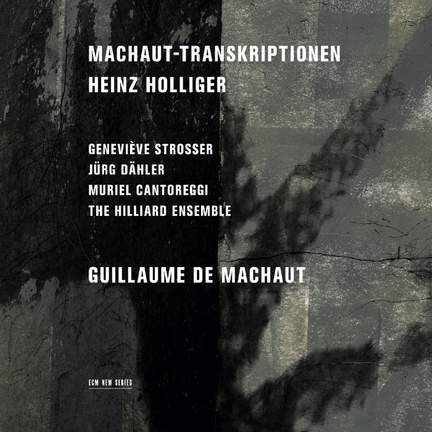
Three Machaut settings, two ballades and the famous Hoquetus David, are sung with great poise by the Hilliard Ensemble and interleaved with Holliger’s paraphrases for three violas, which use...
Holliger: Machaut Transcriptions
Muriel Cantoreggi (viola), Geneviève Strosser (viola), Jürg Dähler (viola)
The Hilliard Ensemble
Purchase product
Three Machaut settings, two ballades and the famous Hoquetus David, are sung with great poise by the Hilliard Ensemble and interleaved with Holliger’s paraphrases for three violas, which use...
About
Swiss composer Heinz Holliger’s Machaut-Transkriptionen comprises a spacious cycle of pieces written over a ten year period beginning in 2001. An imaginative re-investigation of the work of the great 14th century French composer-poet Guillaume de Machaut, it is scored for four voices and three violas.
Note-for-note transcriptions of Machaut give way to Holliger’s increasingly creative refractions of the music. In Heinz Holliger’s works, the succinct term ‘transcriptions’ conceals multi-layered variants of the enigmatic source material and the most subtle diversification of sound, using the technical possibilities of the 21st century. In the complete, almost one-hour cycle, Machaut’s original compositions, performed a cappella,
have been interwoven with Holliger’s variations. Four of the transcriptions have been arranged for three violas alone. The traditional monophonic Lay VII, Amours doucement me tente, however, appears in a new four-part vocal setting, and in the concluding Complainte from ‘Remede de Fortune’ the singing voices join the violas.
As Holliger notes, his in-depth study of Machaut opened up new vistas for his compositional activity and his admiration for the source material is mirrored in the outstanding performances of the violists and singers. The Machaut-Transkriptionen proves a perfect vehicle for the Hilliard Ensemble’s set skills as interpreters of both old and new music, and this recording, made in 2010 in Zurich, captures the vocal group at the heights of its powers. Their own affinity for Machaut is also documented on their album of his Motets (4724022).
Contents and tracklist
- David James (countertenor), Rogers Covey-Crump (tenor), Steven Harrold (tenor), Gordon Jones (baritone)
- The Hilliard Ensemble
- Recorded: 2010-11-26
- Recording Venue: Radio DRS Studio Zürich
- Geneviève Strosser (viola), Jürg Dähler (viola), Muriel Cantoreggi (viola)
- Recorded: 2010-11-26
- Recording Venue: Radio DRS Studio Zürich
- David James (countertenor), Rogers Covey-Crump (tenor), Steven Harrold (tenor), Gordon Jones (baritone)
- The Hilliard Ensemble
- Recorded: 2010-11-26
- Recording Venue: Radio DRS Studio Zürich
- Geneviève Strosser (viola), Jürg Dähler (viola), Muriel Cantoreggi (viola)
- Recorded: 2010-11-26
- Recording Venue: Radio DRS Studio Zürich
- David James (countertenor), Rogers Covey-Crump (tenor), Steven Harrold (tenor), Gordon Jones (baritone)
- The Hilliard Ensemble
- Recorded: 2010-11-26
- Recording Venue: Radio DRS Studio Zürich
- Geneviève Strosser (viola), Jürg Dähler (viola), Muriel Cantoreggi (viola)
- Recorded: 2010-11-26
- Recording Venue: Radio DRS Studio Zürich
- David James (countertenor), Rogers Covey-Crump (tenor), Steven Harrold (tenor), Gordon Jones (baritone)
- The Hilliard Ensemble
- Recorded: 2010-11-26
- Recording Venue: Radio DRS Studio Zürich
- Geneviève Strosser (viola), Jürg Dähler (viola), Muriel Cantoreggi (viola)
- Recorded: 2010-11-26
- Recording Venue: Radio DRS Studio Zürich
- Geneviève Strosser (viola), Jürg Dähler (viola), Muriel Cantoreggi (viola), David James (countertenor), Rogers Covey-Crump (tenor), Steven Harrold (tenor), Gordon Jones (baritone)
- The Hilliard Ensemble
- Recorded: 2010-11-26
- Recording Venue: Radio DRS Studio Zürich
Awards and reviews
 12th November 2015
Three Machaut settings, two ballades and the famous Hoquetus David, are sung with great poise by the Hilliard Ensemble and interleaved with Holliger’s paraphrases for three violas, which use the procedures of the originals to create a music of fragile harmonics and buzzing dissonances.
New York Times 25th November 2015
The transcriptions project has Mr. Holliger’s customary, total elegance, as well as a tenderness that reaches, composer to composer, across centuries. The performers are attentive and passionate, and the recorded sound vivid enough to capture the violists’ intakes of breath as they cue each other.