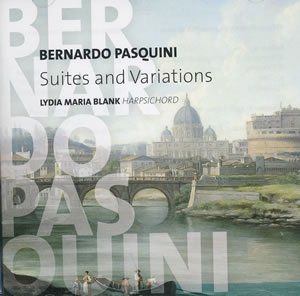
Bernardo Pasquini: Suites and Variations
Lydia Maria Blank (harpsichord)
Blank, a harpsichordist whose previous recordings suggest a relish of tougher assignments than this, certainly finds in [Pasquini] a vein of eloquence and sureness of touch at the keyboard that...
Bernardo Pasquini: Suites and Variations
Lydia Maria Blank (harpsichord)
Purchase product
Blank, a harpsichordist whose previous recordings suggest a relish of tougher assignments than this, certainly finds in [Pasquini] a vein of eloquence and sureness of touch at the keyboard that...
About
Bernardo Pasquini (1637–1710) is considered as the most important Italian composer of keyboard music between Girolamo Frescobaldi (1583–1643) and Domenico Scarlatti (1685–1757). Together with Alessandro Melani (1639–1703), Alessandro Stradella (1644–1682) and Alessandro Scarlatti (1660–1725), he was also one of the most successful composers of Roman oratorios and operas. And as a harpsichordist he was a sorts of alter ego of the highly revered Arcangelo Corelli (1652–1713). Both often worked together and, along with Alessandro Scarlatti, were honourably admitted into the Accademia dell’Arcadia on 26 April 1706. Numerous pupils made the pilgrimage from all over Europe to study with Pasquini, including Francesco Gasparini, Giovanni Maria Casini, Georg Muffat, Johann Philipp Krieger and Domenico Zipoli. George Frideric Handel and Domenico Scarlatti must also have known the composer and his playing.
Contents and tracklist
- Lydia Maria Blank (harpsichord)
- Lydia Maria Blank (harpsichord)
- Lydia Maria Blank (harpsichord)
- Lydia Maria Blank (harpsichord)
- Lydia Maria Blank (harpsichord)
- Lydia Maria Blank (harpsichord)
- Lydia Maria Blank (harpsichord)
- Lydia Maria Blank (harpsichord)
- Lydia Maria Blank (harpsichord)
- Lydia Maria Blank (harpsichord)
- Lydia Maria Blank (harpsichord)
- Lydia Maria Blank (harpsichord)
- Lydia Maria Blank (harpsichord)
- Lydia Maria Blank (harpsichord)
Awards and reviews
 September 2015
Blank, a harpsichordist whose previous recordings suggest a relish of tougher assignments than this, certainly finds in [Pasquini] a vein of eloquence and sureness of touch at the keyboard that make his contemporary reputation understandable.