Bartholomée: Oedipe sur la route
Valentina Valente, Jean-Francis Monvoisin, Hanna Schaer, Ruby Philogene, Nabil Suliman, Jean-Guy Devienne
Symphony Orchestra of La Monnaie, Daniele Callegari
[Bartholomée's] fidelity to a libretto he evidently admired feels almost too great. The vocal parts seem on first hearing to lack individuality in characterisation and give the impression of...
Bartholomée: Oedipe sur la route
Valentina Valente, Jean-Francis Monvoisin, Hanna Schaer, Ruby Philogene, Nabil Suliman, Jean-Guy Devienne
Symphony Orchestra of La Monnaie, Daniele Callegari
Purchase product
[Bartholomée's] fidelity to a libretto he evidently admired feels almost too great. The vocal parts seem on first hearing to lack individuality in characterisation and give the impression of...
About
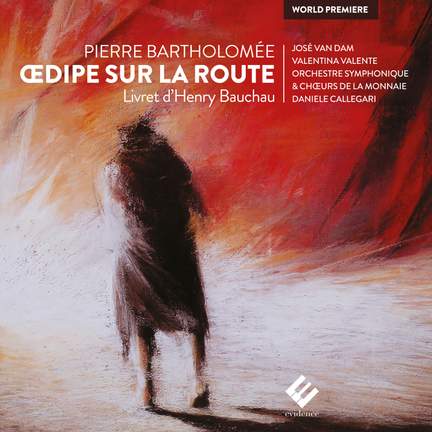
Evidence Classics presents the world première recording of Pierre Bartholomée's 'Oedipe sur la route', based on the 1990 novel by Henry Bauchau and commissioned by La Monnaie. An opera in four acts, 'Oedipe' was first staged in March 2003 in a performance conducted by Daniele Callegari with stage direction by Philippe Sireuil. José Van Dam sang the title role with a superb cast of soloists that includes Italian soprano Valentina Valente in a disturbingly beautiful contemporary work that explores the themes of man and fate. 'Oedipe sur la route' calls for considerable musical and stage forces: a symphony orchestra, a chorus (generally invisible), 12 solo singers, two silent actors and a few extras. There are four acts. The first has something of a very free sonata form. Oedipus wants to leave, go 'anywhere outside of Thebes'. Antigone follows him. Clios, a bandit, suddenly appears and attacks Antigone. Fight. Oedipus brings him down. Clios tells about Alcyon, enemy clans, the mountains, the drama of his life. Oedipus and Antigone listen, dumbfounded. The story is tragic. Fragile bonds are formed. Clios wants to accompany Oedipus. They will henceforth be three on the road to 'no matter where'. A sea interlude leads to Act II, a sort of dramatic scherzo. Oedipus works and raves. In the midst of a storm, he works furiously. He wants to sculpt 'a boat and its rowers' in the immense cliff face overhanging the sea. In Act III, the 'slow movement', Oedipus seeks to return to the community of men. He meets Diotima the sibyl. She wants to deliver him from himself: 'you are clear-voiced'. He sings to her of Jocasta and the Sphinx. It is learnt that the plague is invading the villages. Diotima sends Oedipus to care for the ailing. He soon falls victim to the terrible disease. Death is at hand. In an offering of his whole being, Calliope brings him back to life. 'The night dogs', final interlude, a haunting evocation of one of the most gripping collateral narratives of the novel, leads into Act IV, that of the fulfilment: Oedipus arrives in Colona and enters the Sacred Wood. He is henceforth 'clairvoyant'. The final song, adieus: it is the end of the road.
Contents and tracklist
- The Monnaie Symphony Orchestra, Daniele Callegari
- Daniele Callegari, Choir of La Monnaie, The Monnaie Symphony Orchestra, Marc Coulon, Valentina Valente, Jean-Guy Devienne, José van Dam
- Choir of La Monnaie, Valentina Valente, Daniele Callegari, The Monnaie Symphony Orchestra
- Daniele Callegari, The Monnaie Symphony Orchestra, José van Dam
- The Monnaie Symphony Orchestra, Daniele Callegari, José van Dam, Luc de Meulenaere, Elise Gäbele, Valentina Valente
- The Monnaie Symphony Orchestra, Daniele Callegari
- Daniele Callegari, The Monnaie Symphony Orchestra, Jean-Francis Monvoisin, José van Dam, Valentina Valente
- Daniele Callegari, The Monnaie Symphony Orchestra, Jean-Francis Monvoisin, José van Dam, Valentina Valente
- Daniele Callegari, The Monnaie Symphony Orchestra, Jean-Francis Monvoisin, José van Dam, Valentina Valente
- The Monnaie Symphony Orchestra, Daniele Callegari
- Daniele Callegari, José van Dam, The Monnaie Symphony Orchestra, Jean-Francis Monvoisin
- Daniele Callegari, The Monnaie Symphony Orchestra, Jean-Francis Monvoisin, José van Dam, Valentina Valente
- Choir of La Monnaie, Daniele Callegari, The Monnaie Symphony Orchestra, José van Dam, Jean-Francis Monvoisin
- Choir of La Monnaie, Daniele Callegari, The Monnaie Symphony Orchestra, Valentina Valente, Jean-Francis Monvoisin
- Daniele Callegari, The Monnaie Symphony Orchestra, Jean-Francis Monvoisin, José van Dam, Valentina Valente
Awards and reviews
 September 2015
[Bartholomée's] fidelity to a libretto he evidently admired feels almost too great. The vocal parts seem on first hearing to lack individuality in characterisation and give the impression of continuous recitative. The range of vocal colour that the mature José van Dam, alone of the featured cast, predictably brings to his role is even more of a blessing than normal.
 December 2015
Yet despite the large size of its performing forces and the grandness of its reach, the opera’s scale is small, its dimensions narrow, its emotional range tightly circumscribed. The precise details, the exact changes of sonic colour, though many and exquisitely wrought, are those of the miniature—striking if one is attending closely, but lost in the space of an aural ‘blink’ if one is not. The fabulous and moving heights of lyricism to which the score finally soars are a reminder of the sorts of writing that its tight circumscriptions have seemed to place out of bounds.
 26th June 2015
Heras-Casado is better known now as an interpreter of Romantic and contemporary orchestral music and operas, but he grew up steeped in baroque music...and makes an excellent job of delineating this luscious polyphony...you won’t hear this exuberant music more persuasively championed than it is here.