Postcard from Heaven
Susan Allen (harp)
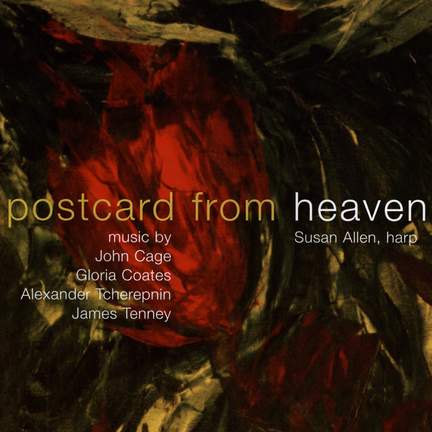
Postcard from Heaven
Susan Allen (harp)
Purchase product
About
The harp is a strange and compelling instrument that in its technological ancientness beckons composers and listeners alike to bask in its heavenly aura. Like hand drums and acoustic guitars, the immediacy of a harp’s sound production demands an intimate, one-on-one relationship between listener and instrument/performer. This intimacy is why composers of all stripes write music for harp—it strips away habit and affectation. Its limits are challenges that distill the essence of a composer’s style and technique and reflect them back as if from a mirror.
John Cage (1912–1992) composed In a Landscape in 1948. The work’s title is revealing: Cage places both sound and its hearing in an environment. James Tenney’s (1934–2006) Harmonium No. 3 (1980) brings three harps together in an ensemble that deceives the ear, sounding like a single instrument. Alexander Tcherepnin (1899– 1977) lived a musical life that spanned the globe. His music reflects his diverse experiences and the many cultures which he came in contact with during his life. Tcherepnin’s Quatre Caprices Diatoniques (1977) are brief musical bonbons originally intended for the non-pedal Breton harp. They work equally well on modern pedal harps, as played here by Ms. Allen.
Gloria Coates’ (b. 1938) score for Perchance to Dream (2014) is deceptively simple. Her use of triadic harmonies and diatonic melody is modified by altering the tuning of the harp and the bowing of the vibraphone. These key characteristics create the piece’s hallmark otherworldly quality. Postcard From Heaven (1992), for 1 to 20 harps, was one of Cage’s last works. The work consists of a collection of “ragas” (predetermined scale patterns featuring set pedal configurations for the harp), that the performers are free to choose how many and in which order they wish to play. Performers are instructed to begin and end the piece using e-bows, a magnetic device that causes steels strings to vibrate without being plucked. The e-bow creates a soft, sustained tone one would rather expect for a postcard from a destination such as heaven.
Contents and tracklist
- Susan Allen
- Susan Allen, Ellie Choate, Marilu Donovan
- Susan Allen
- Susan Allen, Colton Lytle
- Susan Allen, Marilu Donovan, Jillian Risigari-Gai, Jaclyn Urlik