Special offer. Mahler: Symphony No. 3
Ewa Marcinec (contralto)
Boys of the Mainzer Domchors, Ladies of the Domkantorei Mainz, Staatsorchester Rheinische Philharmonie, Daniel Raiskin
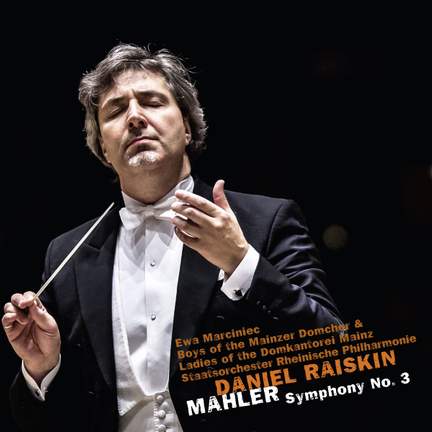
Mahler's biggest symphony gets an appropriately meaty performance from unfamiliar forces. Exciting, but it wears its heart on its sleeve in the religioso treatment of the last movement.
Special offer. Mahler: Symphony No. 3
Ewa Marcinec (contralto)
Boys of the Mainzer Domchors, Ladies of the Domkantorei Mainz, Staatsorchester Rheinische Philharmonie, Daniel Raiskin
Purchase product
Mahler's biggest symphony gets an appropriately meaty performance from unfamiliar forces. Exciting, but it wears its heart on its sleeve in the religioso treatment of the last movement.
About
The composer who dared such open rivalry with God himself was also a brilliant conductor. “Architecture is music in space, as it were a frozen music”, Schelling once wrote, and Mahler applied this in his conducting style: music is architecture transposed into the dimension of time – moving, flowing architecture. Instead of merely tracing the outlines of fellow-artists’ musical blueprints with a schoolboyish hand, Mahler built forms based on the drawings of great musical architects. To Mahler, the actual process of constructing a musical form – its deployment along the axis of time – was infinitely more important than the ultimate goal, a perfectly formed crystal.
Therein lies Mahler’s most important contribution to the aesthetics and practice of conducting. He was the first to comprehend Wagner’s aversion to “crystalline form”. Instead, as a composer and as a conductor, he consistently applied the concept of form as process. Whenever he conducted his own symphonies, Mahler enjoyed the advantage of combining two roles into one: he acted as a musical architect and, at the same time, as a master builder who could immediately bring his construction project into fruition in the concert hall. Every bit as significant, however, were the decisive consequences Mahler drew from Wagner’s pronouncements on the future of the symphony and of instrumental music in general.
Contents and tracklist
- Daniel Raiskin bad, Ewa Marciniec, Boys of the Mainzer Domchor, Ladies of the Domkantorei Mainz, Staatsorchester Rheinische Philharmonie, Peter Moenkediek, Philharmonisches Staatsorchester Mainz
- Daniel Raiskin bad, Ewa Marciniec, Boys of the Mainzer Domchor, Ladies of the Domkantorei Mainz, Staatsorchester Rheinische Philharmonie, Peter Moenkediek, Philharmonisches Staatsorchester Mainz
Awards and reviews
 August 2015
Mahler's biggest symphony gets an appropriately meaty performance from unfamiliar forces. Exciting, but it wears its heart on its sleeve in the religioso treatment of the last movement.