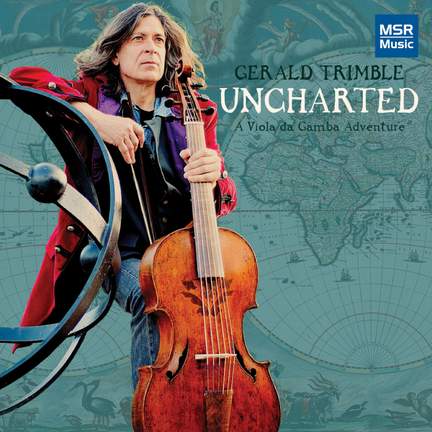
Uncharted
A Viola da Gamba Adventure
Gerald Trimble
Trimble’s free and natural style brings its own authenticity to these old tunes. Whilst Trimble crosses many boundaries, his natural and fine musicianship manages to bring performances that...
Uncharted
A Viola da Gamba Adventure
Gerald Trimble
Purchase product
Trimble’s free and natural style brings its own authenticity to these old tunes. Whilst Trimble crosses many boundaries, his natural and fine musicianship manages to bring performances that...
About
Gerald Trimble, viola da gamba innovator, is the primary exponent of a new style of playing an ancient instrument. His visionary and virtuosic playing combines Celtic, Eastern and Early Music influences with modern techniques and improvisational skills that span several centuries – from Baroque to jazz – seamlessly uniting the entire continuum.
With roots in late 15th century Moorish Spain, the viola da gamba was played throughout Europe until the later 18th century. Since the end of the 19th century, it has enjoyed a revival which continues to grow in popularity. Nevertheless, the viola da gamba remains, despite some experimentation and a handful of modern compositions, a predominately historical instrument for performing period music from written sources.
Trimble’s playing, while historically informed and respectful of traditions, surpasses the known boundaries of the instrument, connecting the cultures which produced it, and transcending the ages which developed it. Unlike the majority of conservatory players today, his style reflects the folk, improvisational and Eastern foundations of the viola da gamba – integral parts of its lineage. Additionally, Trimble expresses a more complete and updated technical potential by adapting bowed and plucked technical skills from Indian music, jazz and contemporary genres, and also incorporates non-standard tunings of his own devising (known historically as playing “lyra way”). In so doing, he re-defines the instrument as one for our time, creating the foundation for a new tradition: the viola da gamba as a world instrument.
A native of Kansas City, Missouri, Gerald Trimble was born November 20, 1957. His early musical experience began with guitar and singing. After years of travel and performing in England and Ireland, he forged a reputation as a leading player of the cittern in Celtic music, releasing three records which are now considered classics. He studied jazz theory with the late John Elliott, Indian classical theory and technique with sitarist Acharya Roop Verma (a disciple of Pandit Ravi Shankar and Ustad Ali Akbar Khan), and Indian vocal technique with Pandit Pran Nath, Hema Sharma and Nirmal Singh. Under the tutelage of Bora Özkök, he began years of travel and study in Turkey and became proficient on numerous Eastern lutes, including the saz, lavta, tar and setar. His introduction to bowed instruments began with the kemanche, a skin-covered gourd-shaped spike fiddle. Its upright playing position and underhand bow grip (the earliest known method which transferred to viols from its Eastern origins) both prepared him technically as a viola da gamba player, and provided a different learning background. Gerald Trimble’s musical exploration and innovation lead the listener to realms which can only be described as ... uncharted.
Contents and tracklist
- Gerald Trimble, River Guerguerian
- Gerald Trimble, River Guerguerian, Webster Williams
- Gerald Trimble, River Guerguerian, Juan Camillo Reyes
Awards and reviews
The Classical Reviewer
Trimble’s free and natural style brings its own authenticity to these old tunes. Whilst Trimble crosses many boundaries, his natural and fine musicianship manages to bring performances that are often quite intoxicating. The recording is fairly close but provides much fine detail. There are useful notes and full instrumental details... I do hope that this new release will gain an equally enthusiastic response from music lovers across the spectrum.