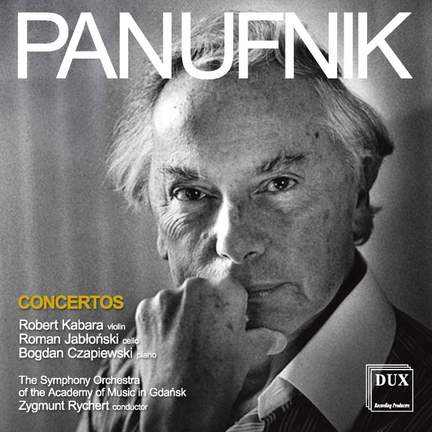
Panufnik: Concertos
Robert Kabara (violin), Roman Jabłoński (cello), Bogdan Czapiewski (piano)
Orkiestra Symfoniczna Akademii Muzycznej im. Stanisława Moniuszki w Gdańsku, Zygmunt Rychert
Andrzej Panufnik's distinctiveness was never more strongly in evidence than in one of his last works, the Cello Concerto of 1991…there's a positive rawness about this performance that suits...
Panufnik: Concertos
Robert Kabara (violin), Roman Jabłoński (cello), Bogdan Czapiewski (piano)
Orkiestra Symfoniczna Akademii Muzycznej im. Stanisława Moniuszki w Gdańsku, Zygmunt Rychert
Purchase product
Andrzej Panufnik's distinctiveness was never more strongly in evidence than in one of his last works, the Cello Concerto of 1991…there's a positive rawness about this performance that suits...
About
Andrzej Panufnik was born on 24 September 1914 in Warsaw, in a family with musical traditions. His father, Tomasz, was a highly regarded violin maker, while his mother, Matylda Thonnes, was a fine violinist. From 1932 to 1936 Panufnik studied at the Warsaw Conservatory, in composition with Kazimierz Sikorski and in conducting with Walerian Bierdiajew. In the late 1940s, Panufnik led the way among modern Polish composers and works he wrote then, like Lullaby for 29 string instruments and 2 harps and Nocturne for orchestra, remain a testimony to the most advanced sonic experiments carried out in Poland at that time. In addition, Panufnik was very active as a conducto. Thus in July 1954, taking advantage of a brief visit to Zurich to make some recordings, he flew from there to London, where he asked for political asylum.
Contents and tracklist
- Robert Kabara
- Orkiestra Symfoniczna Akademii Muzycznej im. Stanisława Moniuszki w Gdańsku
- Zygmunt Rychert
- Roman Jabłoński
- Orkiestra Symfoniczna Akademii Muzycznej im. Stanisława Moniuszki w Gdańsku
- Zygmunt Rychert
- Bogdan Czapiewski
- Orkiestra Symfoniczna Akademii Muzycznej im. Stanisława Moniuszki w Gdańsku
- Zygmunt Rychert
Awards and reviews
 October 2015
Andrzej Panufnik's distinctiveness was never more strongly in evidence than in one of his last works, the Cello Concerto of 1991…there's a positive rawness about this performance that suits the music well…as well the Cello Concerto, the overall atmosphere [of the Concerto for violin and strings] - well realised in this lively recording - is entirely personal to Panufnuk.