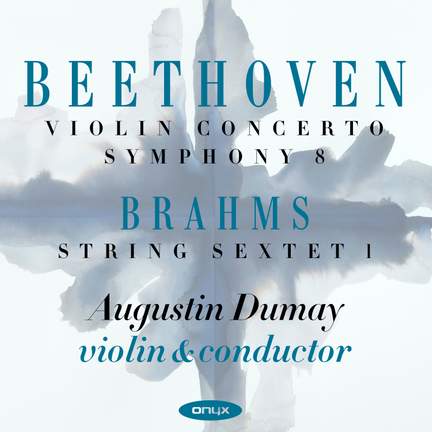
Beethoven: Violin Concerto & Symphony No. 8
Augustin Dumay (violin, conductor), Augustin Dumay, Miguela da Silva, Svetlin Roussev, Henri Demarquette, Marie Chilemme, Aurelien Pascal (sextet)
Sinfonia Varsovia, Kansai Philharmonic
The familiar warmth is still there, but now there's a much firmer sense of disciplined purposefulness, and barely a rubato in sight. Whatever your opinions on the morality of style, there's...
Beethoven: Violin Concerto & Symphony No. 8
Augustin Dumay (violin, conductor), Augustin Dumay, Miguela da Silva, Svetlin Roussev, Henri Demarquette, Marie Chilemme, Aurelien Pascal (sextet)
Sinfonia Varsovia, Kansai Philharmonic
Purchase product
The familiar warmth is still there, but now there's a much firmer sense of disciplined purposefulness, and barely a rubato in sight. Whatever your opinions on the morality of style, there's...
About
Augustin Dumay, one of the great exemplars of the Franco-Belgian school of violinist (Ysaye, Vieuxtemps, Wienawski, Grumiaux) appears on his new recording as soloist and conductor in a concerto that is contemporaneous with the foundation of what would become known as the Franco-Belgian school. Viotti played an important role in the early years of the movement, and his influence can be heard in Beethoven's great D major concerto of 1806, which after a less than successful premiere and years of neglect, until championed by Joachim in the 1850s, is now considered one of the greatest concertos for the violin. Distinctly chamber-like in mood, the solo part is extremely challenging and exposed, with nowhere to hide, and with no overtly flashy displays of virtuosity for the soloist. The concerto is partnered with Beethoven's compact, extrovert and high spirited 8th Symphony of 1812. Less well received than its companion of the same year, the A major 7th Symphony, Beethoven spoke of his affection for the 8th, and the music captures his boisterous humour, especially in the closing minutes of the work. The second CD is devoted to a third facet of Dumay's artistry: chamber music. Brahms' first String Sextet sees him joined by young musician friends. Brahms commenced his chamber music for strings not with a quartet, which would have invited comparison with Beethoven, but with a sextet. The darker sounds of the additional instruments provided a richer, darker sonority that suited Brahms' complex and rich contrapuntal and tonal palate. The work's premiere was led by Joseph Joachim, the champion of Beethoven's concerto, and a great friend of Brahms and the Schumanns.
Contents and tracklist
- Augustin Dumay, Kansai Philharmonic Orchestra
- Augustin Dumay, Svetlin Roussev, Miguel Da Silva, Marie Chilemme, Henri Demarquette, Aurélien Pascal
Awards and reviews
 October 2015
The familiar warmth is still there, but now there's a much firmer sense of disciplined purposefulness, and barely a rubato in sight. Whatever your opinions on the morality of style, there's a lovely generosity and enthusiasm about Dumay's playing and direction that makes it all very hard to resist
 July 2015
Perhaps not every gesture convinces, but better that than an anodyne, safety-first approach; rest assured, there's no whiff of stale routine, and Dumay's customary stylish, raptly intense showing, to say nothing of his subtly variegated tonal palette, will enthral his many admirers.