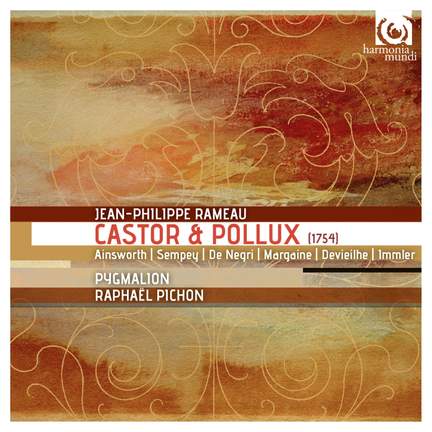
Rameau: Castor et Pollux
Colin Ainsworth (Castor), Florian Sempey (Pollux), Emmanuelle de Negri (Télaire), Clémentine Margaine (Phoebe), Christian Immler (Jupiter), Sabine Devieilhe (Cléone), Philippe Talbot (Mercury), Virgile Ancely (High Priest)
Ensemble Pygmalion, Raphaël Pichon
Emmanuelle de Negri delivers a plangent account of Télaïre's Act II lament 'Tristes apprêts'...Clémentine Margaine is a characterful Phébé with a powerful, coppery chest voice...Though the Underworld...
Rameau: Castor et Pollux
Colin Ainsworth (Castor), Florian Sempey (Pollux), Emmanuelle de Negri (Télaire), Clémentine Margaine (Phoebe), Christian Immler (Jupiter), Sabine Devieilhe (Cléone), Philippe Talbot (Mercury), Virgile Ancely (High Priest)
Ensemble Pygmalion, Raphaël Pichon
Purchase product
Emmanuelle de Negri delivers a plangent account of Télaïre's Act II lament 'Tristes apprêts'...Clémentine Margaine is a characterful Phébé with a powerful, coppery chest voice...Though the Underworld...
About
In contrast to its reception in 1737, 'Castor et Pollux' enjoyed great success in 1754 and it was given regularly until 1755. It was revived again at court in November 1763, then at the Académie Royale de Musique from January 1764 (six months before the elderly Rameau’s death) until 1765, and continued to receive frequent performances from 1770 to 1782: eloquent testimony to its popularity. Thanks to the recent discovery of a manuscript close to the autograph that Rameau finalised in the last months of 1753, this second version of the work, with its tauter dramatic action, can now be heard in the pristine splendour and refinement of its orchestration. As a result the revised tragédie lyrique, unfairly overshadowed nowadays by the 1737 version, emerges in its full force and dramatic power under the inspired direction of Raphaël Pichon.
Contents and tracklist
Awards and reviews
 August 2015
Emmanuelle de Negri delivers a plangent account of Télaïre's Act II lament 'Tristes apprêts'...Clémentine Margaine is a characterful Phébé with a powerful, coppery chest voice...Though the Underworld never sounds as terrifying as it does in Hippolyte et Aricie, this is a compelling and polished performance.
 July 2015
As usual with Rameau, the dance music is a delight, and it's beautifully played. Another pleasure is the high-quality casting of Philippe Talbot and Sabine Devieilhe in minor roles...[Ainsworth's] voice is still in excellent shape, the top notes light and unforced, while his declaiming of the text sounds free and natural...All in all this is a splendid achievement.
 September 2015
Pichon’s direction captures admirably both the lyrical fragility of the score and its moments of dramatic intensity, in the process drawing outstanding playing and singing from his Pygmalion sources … Emanuelle de Negri is a touching, sensitive Telaire, convincingly contrasted with the jealous, mercurial Phebe of Clementine Margaine, whose compelling and strongly projected singing includes impressive chest notes
 23rd May 2015
The performance under the direction of Raphaël Pichon is excellent: clean, precise, refined and airy, cast with largely Francophone singers who have an instinctive understanding of Rameau’s rhythmic vocabulary as well as superb clarity of diction.
Early Music Today June/August 2015
Pichon uses a responsive, youthful-sounding chorus of 21…along with some excellent orchestral playing.