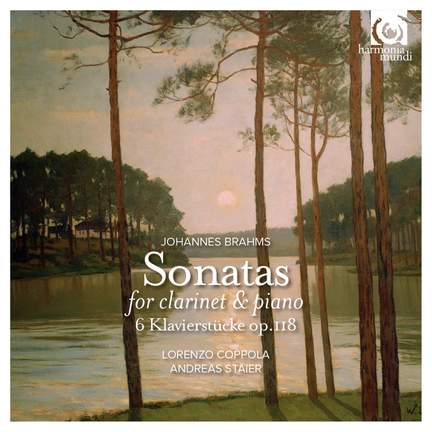
Brahms: Clarinet Sonatas
Lorenzo Coppola (clarinet in B flat after Bärmann Ottensteiner, by Schwenk & Seggelke, Bamberg, 2001) & Andreas Staier (Steinway & Sons piano, New York, 1875)
The two instruments blend so well that clarinet phrases can sometimes seem to emerge from the piano timbre and dissolve back into it again…the restless changefulness in colour and mood that...
Brahms: Clarinet Sonatas
Lorenzo Coppola (clarinet in B flat after Bärmann Ottensteiner, by Schwenk & Seggelke, Bamberg, 2001) & Andreas Staier (Steinway & Sons piano, New York, 1875)
Purchase product
The two instruments blend so well that clarinet phrases can sometimes seem to emerge from the piano timbre and dissolve back into it again…the restless changefulness in colour and mood that...
About
The two sonatas for clarinet and piano, composed in 1894, were Brahms’s last chamber works. Knowing that he could count on the virtuosity of their dedicatee, the prodigious clarinettist Richard Mühlfeld (1856-1907), Brahms enthusiastically exploited all the expressive possibilities of the instrument. Under the fingers of Lorenzo Coppola, the clarinet prays, sobs, dreams or laughs, bringing astonishing conviction to all these varied emotions.
Both Andreas Staier and Lorenzo Coppola contribute booklet notes for this release and in particular they have this to say about the 1875 Steinway used in the recording:
"The grand pianos of Steinway & Sons of New York were the most advanced of their time. They won a gold medal at the Paris International Exposition of 1867, and their technical innovations were eventually to be adopted by all European piano makers. The instruments, which were again honoured at the Centennial Exhibition in Philadelphia in 1876, may be said to mark the end of the development of piano building: with them, today’s concert grand was created, which has since been modified only in minor details. The instrument used in this recording is numbered 32500 and dates from the year 1875.
In Brahms’s later years, Steinway grand pianos were among his favourite instruments. On 18 November 1881, for example, he wrote to Julius Otto Grimm: ‘Be so good as to inquire in Cologne or elsewhere if they cannot send us a Bechstein or Steinway. I will gladly pay the transport costs. But I will no longer play on any dubious or questionable instrument.’
We sincerely thank Chris Maene for making his original Steinway available to us for this recording and the rehearsals that preceded it. We spent a very pleasant few days in his collection of instruments in Ruiselede, where we were also enjoyed the most generous hospitality."
Contents and tracklist
Awards and reviews
 September 2015
The two instruments blend so well that clarinet phrases can sometimes seem to emerge from the piano timbre and dissolve back into it again…the restless changefulness in colour and mood that these players find, especially in the F minor Sonata, certainly invites us to listen afresh.
CD Review 25/04/2015
[music] you could hear both players exploiting there the intimacy of their two characters as the balance changes. Lorenzo writes persuasively in the notes about the colours moods and characters he hears in the two Brahms sonatas – these would be musically rewarding performances on modern instruments but embracing 19th century technology to such persuasive effect gives it an added dimension.
 July 2015
Clashes of personality don't occur between Coppola and Staier. They interpret the texts within a framework of mutually passionate advocacy, rubato expressed through an elasticity of tempo that hews closely to the pulse, clean textures achieved through playing that reflects the timbres of each instrument...Superlatives all round.
 April 2015
Lorenzo Coppola has an ample, flexible, bright tone … there is a wonderful polished sheen to his playing, coupled with a poignant touch in the lyrical slow movements and a rich sonority when the clarinet is in its lowest registers. Musically these are thoroughly engaging performances, injected with fire when appropriate but also retreating into reflective territory where the poise of the clarinet playing is at its most affecting.
 April 2015
Staier and Coppola’s characterful playing seeks out muted shadings, blends and balances that constantly surprise the ear.