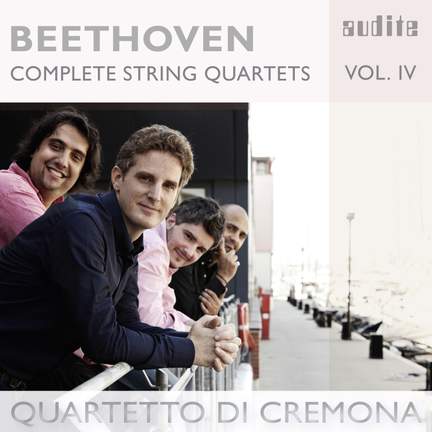
Beethoven: Complete String Quartets Volume 4
Quartetto di Cremona
Beethoven's most experimental in the medium. The playing, as ever, is blisteringly detailed and right in your face: you can feel the grain of the music and actually hear the fierce tension of...
Beethoven: Complete String Quartets Volume 4
Quartetto di Cremona
Purchase product
Beethoven's most experimental in the medium. The playing, as ever, is blisteringly detailed and right in your face: you can feel the grain of the music and actually hear the fierce tension of...
About
For their fourth volume of Ludwig van Beethoven’s String Quartets, the Quartetto di Cremona have chosen two works forming a portal within his quartet writing.
Beethoven had opened his Op. 18 set with the Quartet in F major, written in 1798/99 at the behest of his patron and friend, Prince Lobkowicz. Despite the mellifluous, pastoral key, the music draws a long line from the brilliantly crafted first and last movements to the dark hues of the Adagio, apparently inspired by the tomb scene from Shakespeare’s 'Romeo and Juliet'. Even within the framework of the traditional form, Beethoven’s quartet début achieves a maximum of moods and stylistic variety.
Beethoven’s Quartet Op. 131 of 1826, generally perceived as a peak within his chamber music, is entirely different. It was written in the shadows of the Ninth Symphony and the 'Missa solemnis', but appears much more eccentric and experimental than these two large-scale works. Seven sections of diverse tone and character are played without breaks in between; a brooding fugue stands alongside a sensitive adagio, a folk tune presto is next to a restless finale. The work was written for the Viennese violinist Ignaz Schuppanzigh, whose quartet set the professional playing standard for the following 100 years. Schuppanzigh rehearsed Beethoven’s Op. 131 painstakingly – without him this music, which was deemed not only unplayable but also 'unhearable' by contemporaries, would not exist.
Contents and tracklist
Awards and reviews
The Herald (Glasgow) April 2015
Beethoven's most experimental in the medium. The playing, as ever, is blisteringly detailed and right in your face: you can feel the grain of the music and actually hear the fierce tension of concentration through the players' breathing (part of it; not a distraction) … This gripping Cremona cycle goes from strength to strength.