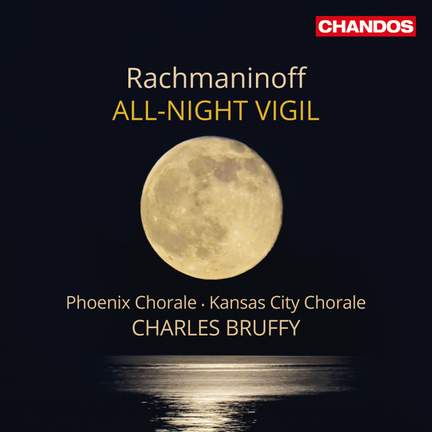
Rachmaninoff: Vespers, Op. 37
Phoenix Chorale & Kansas City Chorale, Charles Bruffy
Awards:
-
Grammy Awards, 58th Awards (2015), Best Choral Performance

No doubt about it, these are two very fine professional choirs, unique in an unparalleled lower-register smokiness and resonance. The basses can reach the famous bottom notes: the C at the end...
Rachmaninoff: Vespers, Op. 37
Phoenix Chorale & Kansas City Chorale, Charles Bruffy
Purchase product
Awards:
-
Grammy Awards, 58th Awards (2015), Best Choral Performance
No doubt about it, these are two very fine professional choirs, unique in an unparalleled lower-register smokiness and resonance. The basses can reach the famous bottom notes: the C at the end...
About
The Grammy-Award-winning conductor Charles Bruffy brings together his two professional choirs, the Kansas City Chorale and Phoenix Chorale, for this recording of Serge Rachmaninoff’s All-night Vigil. The scheduled release date marks the 100th anniversary of the world premiere of the work, which was given by the Moscow Synodal Choir on 10 March 1915.
The recording follows live performances of the work by the combined ensembles in April and May 2014, respectively in Phoenix and Kansas City. The Phoenix Chorale and Kansas City Chorale are regarded as among the finest professional choral ensembles in the world. Their recordings have earned a combined total of ten Grammy-Award-nominations and four wins. Building on the success of previous collaborations, the performances marked the seventh time that the two choirs have performed together. Of their 2009 performance at Alice Tully Hall in New York, Vivien Schweitzer of The New York Times wrote that the choirs ‘performed with a buoyant pulse and energetic finesse’, and praised ‘the choirs’ refined sound and elegant phrasing’.
Serge Rachmaninoff’s All-night Vigil stands as the crowning achievement of the ‘Golden Age’ of Russian Orthodox sacred choral music. The texts are drawn from the Russian Orthodox liturgy and the music goes beyond the strict requirements of the liturgical ritual, making it better suited for concert presentations of sacred choral music than for worship services.
Contents and tracklist
- Bryan Taylor (bass), Paul Davidson (bass), Julia Scozzafava (mezzo-soprano), Toby Vaughn Kidd (bass), Frank Fleschner (tenor), Joseph Warner (bass), Bryan Pinkall (tenor)
- Phoenix Chorale, Kansas City Chorale
- Charles Bruffy
- Recorded: 24-26 May 2014
- Recording Venue: Cathedral of St Peter the Apostle, Kansas City, Kansas, United States
Awards and reviews
 June 2015
No doubt about it, these are two very fine professional choirs, unique in an unparalleled lower-register smokiness and resonance. The basses can reach the famous bottom notes: the C at the end of 'Blessed is the Man' is a wonder…any claim to Russian Orthodox authenticity, though, is cancelled out with the cowled sound of the sopranos
 May 2015
The combined 56 voices are beautifully balanced balanced...Intonation is spot-on throughout this taxing work and there are no audible edits...In addition to coaxing an ultra-smooth blend to the choral sound Bruffy has also...rubbed off some of the crispness of articulation...[Scozzafava's] alto osolo sounds like the genuine article.
 May 2015
there will be purists who will object on principle to a non-Russian choir in this work, but previous recordings have demonstrated beyond doubt that this combined chorus possesses the style to an admirable degree, and I very much hope that this first-rate recording will do more to bring this masterpiece to a wider listening public - it certainly deserves to.
 27th March 2015
It’s been a long time since I’ve heard choral singing of this quality. This is a very beautiful and inspired reading of Rachmaninov’s wonderful settings and I found it very rewarding indeed.
 13th March 2015
Charles Bruffy and the Phoenix and Kansas City Chorales have long been outstanding interpreters of this repertory and their performance has a devotional intensity that is often overwhelming. The recording itself is on the reverberant side. But by the end, you know exactly why it one of Rachmaninov’s favourites among his own works, and why many consider it his greatest.