Special offer. Félicien David: Le Désert
Cyrille Dubois (tenor), Zachary Wilder (tenor) & Jean-Marie Winling (speaker)
accentus & Orchestre de Chambre de Paris, Laurence Equilbey
The 'Call of the Muezzin' is [a] high point in this excellent performance, Zachary Wilder soaring up to top Bs which in 1844 no doubt set the ladies in the audience all of a-flutter. Good fun...
Special offer. Félicien David: Le Désert
Cyrille Dubois (tenor), Zachary Wilder (tenor) & Jean-Marie Winling (speaker)
accentus & Orchestre de Chambre de Paris, Laurence Equilbey
Purchase product
The 'Call of the Muezzin' is [a] high point in this excellent performance, Zachary Wilder soaring up to top Bs which in 1844 no doubt set the ladies in the audience all of a-flutter. Good fun...
About
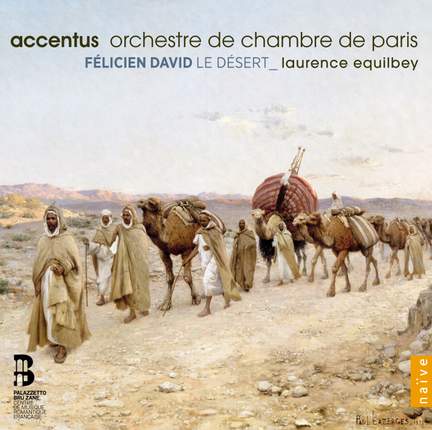
Conducted by Laurence Equilbey and featuring the renowned Accentus choir and Orchestre de Chambre de Paris, this new recording of one of the French masterpieces of the mid-19th century is a real discovery. French composer Félicien David spent 4 years in Egypt and Algeria before returning to Paris, where he composed this romantic 'ode symphonie' which pandered to the popular orientalist trend and was a huge success throughout Europe. Born in 1810, Félicien David's voyage took him to Egypt and Algeria between 1831 and 1835. He returned to his homeland with the intention of ‘singing of the East’ to French ears and making a name for himself as a composer in Paris - at that time, the musical crossroads of Europe. In December 1844, David reached the heights of fame when his ode-symphonie 'Le Désert' was given at the Théâtre-Italien. Berlioz extended an enthusiastic welcome to the work, in which he saw the reflection of his own aesthetic experiments and in February 1845 he conducted 'Le Désert' himself in a concert at the Cirque des Champs-Élysees.
Berlioz had tried his hand at a mixed genre with 'Roméo et Juliette' in 1839, namely the ‘symphonie dramatique’, midway between the oratorio and the symphony, but in 1844 David ushered in a new manner of conceiving the narrative: he does not project his listeners into the heart of a frenetic action, but rather asks them to observe a landscape, as if they were standing in front of three successive tableaux: a caravan advancing; a nocturnal halt; a sunrise. This phenomenal success, however, such as Berlioz was never to enjoy in his lifetime, had a detrimental effect on David’s future career. The reception of the oratorio 'Moïse au Sinai' (March 1846) already suffered from this factor, and the composer of 'Le Saphir' (premiered at the Opéra Comique in 1865) was even reproached for having ‘got off his camel’. In Le Monde, July 1868, a caricature by the cartoonist Achille Lemont depicted an ageing Félicien David holding a lyre with broken strings, seated on the skeleton of a camel and chained to a post bearing the inscription ‘Désert a perpétuité’ . . .
Contents and tracklist
- Cyrille Dubois (tenor), Zachary Wilder (tenor)
- Accentus Chamber Choir, Orchestre de Chambre de Paris
- Laurence Equilbey
- Recorded: May 2014
- Recording Venue: Cite de la musique, Paris, France
- Cyrille Dubois (tenor), Zachary Wilder (tenor), Jean-Marie Winling (narrator)
- Accentus Chamber Choir, Orchestre de Chambre de Paris
- Laurence Equilbey
- Recorded: May 2014
- Recording Venue: Cite de la musique, Paris, France
Awards and reviews
 June 2015
The 'Call of the Muezzin' is [a] high point in this excellent performance, Zachary Wilder soaring up to top Bs which in 1844 no doubt set the ladies in the audience all of a-flutter. Good fun all round.
 May/June 2015
On the evidence of this recording, it is a work not merely of charm but rather a forgotten French masterpiece of the 19th century orientalist strand. Equilbey draws expressive playing from her excellent Parisian forces, and the soloists are idiomatic.
 29th March 2015
The four movements evoke, with charming local colour, the Egyptian landscape and a caravan journeying across it. This fine performance occupies two discs, one with narrator, one without.
 26th February 2015
The work, which draws on David’s own travels through north Africa and the Middle East in the 1830s, is not a narrative so much as a series of three descriptive musical tableaux...Equilbey and her choir, Accentus, perform the score twice here...there is more than enough striking music to make it worthwhile.