Revolutions
Hymns to glory or Cries of Death: 1830, 1848, 1871
Isabelle Druet (soprano), Jean-François Novelli (tenor), Arnaud Marzorati (baritone), Yves Rechsteiner (piano) & Antoine Bitran (barrel organ)
Les Lunaisiens
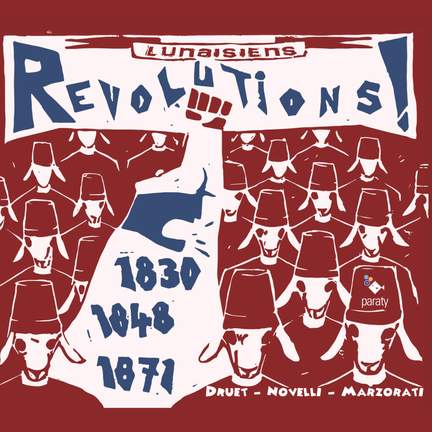
For me this was a wholly absorbing disc to which I have returned with increasing pleasure...The performances are wholly engaged with the music, and perhaps even more with the words. The recording...
Revolutions
Hymns to glory or Cries of Death: 1830, 1848, 1871
Isabelle Druet (soprano), Jean-François Novelli (tenor), Arnaud Marzorati (baritone), Yves Rechsteiner (piano) & Antoine Bitran (barrel organ)
Les Lunaisiens
Purchase product
For me this was a wholly absorbing disc to which I have returned with increasing pleasure...The performances are wholly engaged with the music, and perhaps even more with the words. The recording...
About
Musical chronicles gravitating around the Marseillaise and the three 19th-century revolutions in France After the ancient régime and a brief Napoleonic craze, France took almost a century to define its national symbols. From 1795 to 1879, it took a long, perilous and bloody route for the Marseillaise to definitely become the national anthem of all the French, and for the tricolour flag (saluted by Béranger in his ‘Vieux Drapeau’ [‘The Old Flag’]) to be forever acclaimed as ‘standard of the Republic’.
For an epoch often seen as little more than a long stretch of Romantic infatuation, the 19th century was, above all, a century of battles, resistance and barricades. No fewer than three revolutions in 50 years: the ‘Trois Glorieuses’ of 1830, the Days of February and June 1848, and the 1871 Commune. And we might also mention the Canuts Revolt of 1831 and the June 1832 insurrection, with its drama of the Rue Transnonain… All along these fratricidal battles, battles of streets and cobblestones painted and described by artists like Delacroix, Victor Hugo, Alexandre Dumas or Berlioz, hymns and songs echoedwith the roar of the insurgents’ guns and cannons. It was in this atmosphere, this storm of gunpowder and blood, that songwriters like Pierre Dupont and his ‘Song of Bread’ or ‘Of the Workers’ or Gustave Leroy and his ‘The Ball and the Guillotine’ joined forces with the rebels’ clamour, with committed and vindictive texts taking aim at successive governments that had proved too clumsy to satisfy the will of a population all too often starved and exploited, prey to doubt and to anger. Song of glory or keen of death? May all this music renew the struggles of those men of good will who fought for the three values: Liberty, Equality and Fraternity.
Contents and tracklist
- Arnaud Marzorati, Antoine Bitran, Les Lunaisiens
- Isabelle Druet, Yves Rechsteiner, Les Lunaisiens
- Arnaud Marzorati, Antoine Bitran, Les Lunaisiens
- Isabelle Druet, Jean-François Novelli, Les Lunaisiens
- Antoine Bitran, Les Lunaisiens
- Isabelle Druet, Yves Rechsteiner, Les Lunaisiens
- Jean-François Novelli, Antoine Bitran, Le choeur des révolutionnaires, Les Lunaisiens
- Isabelle Druet, Les Lunaisiens
- Antoine Bitran, Yves Rechsteiner, Les Lunaisiens
- Isabelle Druet, Yves Rechsteiner, Les Lunaisiens
- Antoine Bitran, Arnaud Marzorati, Yves Rechsteiner, Les Lunaisiens
- Isabelle Druet, Arnaud Marzorati, Jean-François Novelli, Les Lunaisiens
- Antoine Bitran, Yves Rechsteiner, Les Lunaisiens
- Antoine Bitran, Arnaud Marzorati, Le choeur des révolutionnaires, Les Lunaisiens
Awards and reviews
 19th January 2015
For me this was a wholly absorbing disc to which I have returned with increasing pleasure...The performances are wholly engaged with the music, and perhaps even more with the words. The recording puts the listener close, possibly too close at times, to the mob and it is hard to resist the sheer fervour of the sentiments expressed.