Boxberg: Sardanapalus
Jan Kobow (Sardanapalus / Apollo), Rinnat Moriah (Salomena / Venus), Theodora Baka (Agrina / Juno), Cornelia Samuelis (Didonia / Diana), Franz Vitzthum (Belochus), Markus Flaig (Arbaces / Mars), Sören Richter (Atrax), Felix Schwandtke (Belesus), Kirline Cirule (Misius / Cupido), Philipp Nicklaus...
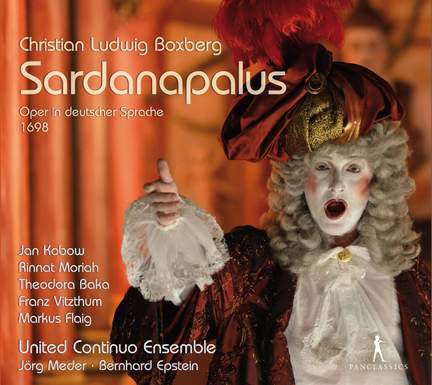
the singing of the countertenor Franz Vitzthum (Belochus) and the bass-baritone Marcus Flaig (Arbaces) is delightful. Also excellent is the bass Felix Schwandtke as Belesus...an interesting...
Boxberg: Sardanapalus
Jan Kobow (Sardanapalus / Apollo), Rinnat Moriah (Salomena / Venus), Theodora Baka (Agrina / Juno), Cornelia Samuelis (Didonia / Diana), Franz Vitzthum (Belochus), Markus Flaig (Arbaces / Mars), Sören Richter (Atrax), Felix Schwandtke (Belesus), Kirline Cirule (Misius / Cupido), Philipp Nicklaus...
Purchase product
the singing of the countertenor Franz Vitzthum (Belochus) and the bass-baritone Marcus Flaig (Arbaces) is delightful. Also excellent is the bass Felix Schwandtke as Belesus...an interesting...
About
Christian Ludwig Boxberg (1670-1729) belongs to the 'lost' generation of composers between Schütz and Bach. For decades, the revival of baroque music has concentrated on these two poles of German Baroque music to such an extent that everything between them can appear imperfect by comparison. Boxberg's 'Sardanapalus', however, is by no means imperfect. On the contrary, we experience here a remarkable synthesis of the various European national styles. Alongside German influences, those of both French and Italian opera are unmistakeable. The very witty libretto was written by Boxberg himself, and retells Diodorus's history of the profligate Assyrian King Sardanapalus who, far from being interested in ruling the land, liked to put on makeup, parade about in women's clothing and give in to acts of salaciousness with both women and men.
Christian Boxberg was himself a pupil at St. Thomas's School in Leipzig, later becoming a singer at the first civic opera house in Leipzig under Nikolaus Adam Strunck, for whom he also wrote several libretti. When the latter, fearing his creditors, no longer dared appear in the city, Boxberg filled the breach, writing several operas for the Leipzig Opera House - none of which has survived to the present day. As luck would have it, the members of the Leipzig Opera undertook a journey in 1698 to Ansbach, where a copy of the score of Sardanapalus was preserved; it is thus one of the earliest surviving operas in the German language. Thanks to the indefatigable commitment of Jörg Meder and his United Continuo Ensemble, this special work has been performed again and is now also available on CD as a live recording.
Artists
Jan Kobow (Sardanapalus / Apollo), Rinnat Moriah (Salomena / Venus), Theodora Baka (Agrina / Juno), Cornelia Samuelis (Didonia / Diana), Franz Vitzthum (Belochus), Markus Flaig (Arbaces / Mars), Sören Richter (Atrax), Felix Schwandtke (Belesus), Kirline Cirule (Misius / Cupido), Philipp Nicklaus (Saropes)
United Continuo Ensemble, Jörg Meder & Bernhard Epstein
Contents and tracklist
- Markus Flaig (bass), Cornelia Samuelis (soprano), Theodora Baka (mezzo-soprano), Rinnat Moriah (soprano), Jan Kobow (tenor), Kirline Cirule (soprano), Franz Vitzthum (countertenor), Sören Richter (tenor), Felix Schwandtke (bass), Philipp Nicklaus (tenor)
- United Continuo Ensemble
- Bernhard Epstein
- Recorded: 28 February and 1 March 2014
- Recording Venue: Wilhelma Theater Stuttgart, Germany
Awards and reviews
 March 2015
the singing of the countertenor Franz Vitzthum (Belochus) and the bass-baritone Marcus Flaig (Arbaces) is delightful. Also excellent is the bass Felix Schwandtke as Belesus...an interesting recording for the Baroque opera enthusiast.
 March 2015
The singing is overall of a high standard with fine contributions from the experienced Jan Kobow, all three women and the basses, who sing the roles of Arbaces and Belesus, the eventual conquerors of Sardanapalus.