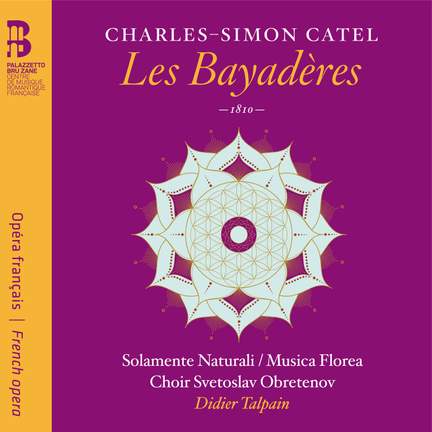
Special offer. Catel: Les Bayadères
Chantal Santon (Laméa), Philippe Do (Démaly), André Heyboer (Olkar), Mathias Vidal (Rustan / Un Chef indien), Katia Velletaz (Ixora / Première Bayadère), Jennifer Borghi (Divané / Deuxième Bayadère), Mélodie Ruvio (Dévéda / Troisième Bayadère), Frédéric Caton (Le Brame Hydérane), Thomas Bettinger...
Throughout the first act the music is invariably charming, but it rarely escapes the niceties of late 18th-century opera comique...Nevertheless the work is well served by this CD...This is an...
Special offer. Catel: Les Bayadères
Chantal Santon (Laméa), Philippe Do (Démaly), André Heyboer (Olkar), Mathias Vidal (Rustan / Un Chef indien), Katia Velletaz (Ixora / Première Bayadère), Jennifer Borghi (Divané / Deuxième Bayadère), Mélodie Ruvio (Dévéda / Troisième Bayadère), Frédéric Caton (Le Brame Hydérane), Thomas Bettinger...
Purchase product
Throughout the first act the music is invariably charming, but it rarely escapes the niceties of late 18th-century opera comique...Nevertheless the work is well served by this CD...This is an...
About
2CD + Book
An admirer of Mozart and a great reformer of music education at the recently opened Paris Conservatoire (1795), Charles-Simon Catel composed in 1810 Les Bayadères, an operatic masterpiece set in India, which competed successfully with Spontini’s La Vestale, which was then at the height of its popularity. Tinged with orientalism, it turns the page on Classicism and uses new musical and dramatic structures to create emotion.
In a work full of action and excitement, the heroine of the opera, the bayadère Laméa – a ‘star’ role (then a new concept) – shows remarkable presence. On his arrival in Paris in the 1820s, the young and very discerning Hector Berlioz was filled with enthusiasm by this work.
Artists
Chantal Santon (Laméa), Philippe Do (Démaly), André Heyboer (Olkar), Mathias Vidal (Rustan / Un Chef indien), Katia Velletaz (Ixora / Première Bayadère), Jennifer Borghi (Divané / Deuxième Bayadère), Mélodie Ruvio (Dévéda / Troisième Bayadère), Frédéric Caton (Le Brame Hydérane), Thomas Bettinger (Rutrem), Éric Martin-Bonnet (Salem / Un Offcier maratte / Iranès), Thill Mantero (Narséa), Kareen Durand (Une Coryphée / Une Bayadère)
Solamente Naturali, Musica Florea & Svetoslav Obretenov National Bulgarian Choir, Didier Talpain
Contents and tracklist
- Solamente Naturali, Musica Florea, Bulgarian National Choir Svetoslav Obretenov, Didier Talpain
- Solamente Naturali, Musica Florea, Bulgarian National Choir Svetoslav Obretenov, Didier Talpain, Katia Velletaz, Jennifer Borghi, Mélodie Ruvio, Mathias Vidal, Kareen Durand
- Solamente Naturali, Musica Florea, Bulgarian National Choir Svetoslav Obretenov, Didier Talpain, Matthias Vidal, Philippe Do
- Solamente Naturali, Musica Florea, Bulgarian National Choir Svetoslav Obretenov, Didier Talpain, Matthias Vidal, Philippe Do, Mathias Vidal, Thomas Bettinger, Thill Mantero
- Solamente Naturali, Musica Florea, Bulgarian National Choir Svetoslav Obretenov, Didier Talpain, Chantal Santon Jeffery, Philippe Do, Mathias Vidal, Thomas Bettinger, Thill Mantero
- Solamente Naturali, Musica Florea, Bulgarian National Choir Svetoslav Obretenov, Didier Talpain, Chantal Santon Jeffery, Philippe Do, Mathias Vidal, Thomas Bettinger, Thill Mantero, Katia Velletaz, Jennifer Borghi, Mélodie Ruvio
- Solamente Naturali, Musica Florea, Bulgarian National Choir Svetoslav Obretenov, Didier Talpain, Chantal Santon Jeffery, Philippe Do, Mathias Vidal, Thomas Bettinger, Thill Mantero
- Solamente Naturali, Musica Florea, Bulgarian National Choir Svetoslav Obretenov, Didier Talpain, Chantal Santon Jeffery
- Solamente Naturali, Musica Florea, Bulgarian National Choir Svetoslav Obretenov, Didier Talpain, Chantal Santon Jeffery, André Heyboer, Eric Martin-Bonnet
- Solamente Naturali, Musica Florea, Bulgarian National Choir Svetoslav Obretenov, Didier Talpain, Chantal Santon Jeffery, André Heyboer
- Solamente Naturali, Musica Florea, Bulgarian National Choir Svetoslav Obretenov, Didier Talpain, Chantal Santon Jeffery
- Solamente Naturali, Musica Florea, Bulgarian National Choir Svetoslav Obretenov, Didier Talpain, Chantal Santon Jeffery, Philippe Do, André Heyboer, Eric Martin-Bonnet
- Solamente Naturali, Musica Florea, Bulgarian National Choir Svetoslav Obretenov, Didier Talpain, André Heyboer, Eric Martin-Bonnet
- Solamente Naturali, Musica Florea, Bulgarian National Choir Svetoslav Obretenov, Didier Talpain, Chantal Santon Jeffery, André Heyboer, Eric Martin-Bonnet
- Solamente Naturali, Musica Florea, Bulgarian National Choir Svetoslav Obretenov, Didier Talpain, Philippe Do
Awards and reviews
 Awards Issue 2015
Throughout the first act the music is invariably charming, but it rarely escapes the niceties of late 18th-century opera comique...Nevertheless the work is well served by this CD...This is an excellent ensemble performance with tight and responsive orchestra accompaniment which rises with gusto to the more modest challenges of the second act...None of the soloists fall short.
 March 2015
Catel's scores wafts along decorously at first...But the music gains in stature as the plot unfurls...Didier Talpain draws punchy if slightly relentless playing from the combined forces of Solamente Naturali and Musica Florea. There are fine soloists, too, led by Philippe Do's eloquent, clean-voiced Démaly and Chantal Santon's Lamea.
 December 2014
The singing and playing are enjoyable, with special mention for Chantal Santon as Lamea...Why is this soprano with her full, rounded voice not better known?...Another good piece of casting is that of the resonant baritone Andre Heyboer as the conquering Olkar...I find after listening to this recommendable performance that the opera does not deserve to languish in obscurity.
 July 2015
Démaly is sung rather carefully by Phillippe Do, while Andre Heyboer is strong and stern as the villainous Olkar; three favourites (inevitably reminiscent of the Three Ladies in the Flute) are appealingly sung by Katia Velletaz, Jennifer Borghi and Melodie Ruvio. Much of Catel’s score is purely charming, but he is invariably skilful and rises to the greater dramatic challenges of the later scenes with considerable aplomb; as a whole it qualifies as a worthwhile rediscovery, and the conductor Didier Talpain highlights both its grace and its refined sensibility.