Röntgen: The Late String Trios
World Première Recordings
Offenburg String Trio
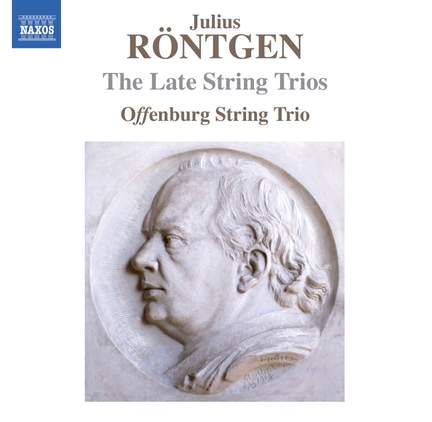
Composed during the 1920s, these late fruits of Rontgen's prolific chamber output are resourceful and nostalgic in style. These performances would benefit from a wider dynamic range.
Röntgen: The Late String Trios
World Première Recordings
Offenburg String Trio
Purchase product
Composed during the 1920s, these late fruits of Rontgen's prolific chamber output are resourceful and nostalgic in style. These performances would benefit from a wider dynamic range.
About
For many decades one of the leading figures in Dutch musical life, Julius Röntgen came from a distinguished musical family and counted Brahms, Grieg, Grainger and Nielsen among his friends. In his later years he composed an important series of works in many genres, among them a sequence of String Trios written for Röntgen to play with his talented sons. The last four, composed between 1925 and 1930, are works of considerable warmth, verve and inventiveness, not least No. 15 in C sharp minor whose fourth movement, Finale automobilistico, was inspired by a Fiat 509A Torpedo car and a family incident-filled holiday in Germany, France, Switzerland and northern Italy.
Contents and tracklist
- Offenburg String Trio
- Offenburg String Trio
- Offenburg String Trio
- Offenburg String Trio
Awards and reviews
 October 2014
Composed during the 1920s, these late fruits of Rontgen's prolific chamber output are resourceful and nostalgic in style. These performances would benefit from a wider dynamic range.
 30th May 2017
[The Offenburg] bring these scores a variety of dynamics, and of modes of attack, that emphasize Röntgen’s textural contrasts; yet their incisive attacks in Trios 14 and 16 are unfailingly attractive. In the first movement of the A major, the viola and cello move in perfectly blended thirds under the violin’s high trill; the soft playing in the C minor’s Andante con tenerezza has a beautiful, fragile delicacy. Ensemble and intonation are most impeccable.
 31st July 2014
Their finely honed style is unashamedly Brahmsian; they make no great claims to profundity, though they sometimes lapse into rather academic counterpoint. They are pieces, I suspect, that are more fun to play than to listen to; certainly the Offenburg Trio present them with great care and sensitivity.