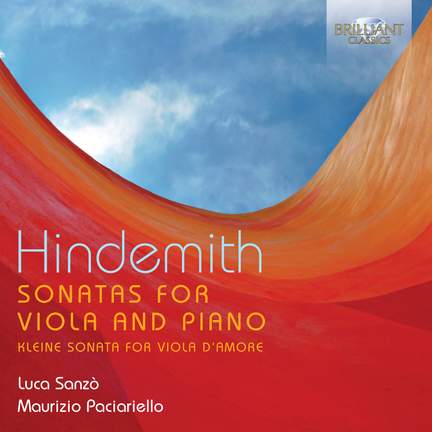
Hindemith: Sonatas for Viola and Piano
Luca Sonzò (viola) & Maurizio Paciariello (piano)
The present performance is strong and whereas it might not hit the heights achieved by some, at the price it is a real winner, especially as it also offers the sonata for viola d’amore. The...
Hindemith: Sonatas for Viola and Piano
Luca Sonzò (viola) & Maurizio Paciariello (piano)
Purchase product
The present performance is strong and whereas it might not hit the heights achieved by some, at the price it is a real winner, especially as it also offers the sonata for viola d’amore. The...
About
The viola’s shadowy veiled timbre and reserved, almost retiring character is such that it is rarely called upon to take the lead.
Granted, a substantial number of concertos were composed for it during the 18th to 19th centuries, but it was not until the 20th century – when several hitherto neglected instruments acquired a new identity in a solo capacity – that the viola became the object of serious attention.
Probably the most underrated composer of the 20th century, it was Paul Hindemith – himself an excellent violist – who was largely responsible for rescuing the instrument from relative oblivion. Detailing a selection of his sonatas for viola (of which there number seven in total – four solo and three with piano,), this release charts the development of the composer’s style – from the post‐war years, the setting of his Sonata Op.11 No.4 and during which time he was experimenting with all the current idioms and trends such as Expressionism and Gebrauchsmusik, to the Sonata in F major of 1939 – written in keeping with his belief that the time had now come to reconnect with the great German tradition, and thus revisiting the formal structures of the Baroque period, such as the fugue. All the while Hindemith’s distinctive style prevails – in the Kleine Sonata of 1922, for example, the composer’s use of the viola d’amore recalls the two arias composed for this instrument in the Johannes Passion, though there are plenty of angular rhythms and pungent dissonances confirming his fidelity to his own interpretation of the musical language of the 1900s. Violist Luca Sanzò and pianist Maurizio Paciariello are the performers on this recording, both soughtafter interpreters of contemporary music as well as conservatoire professors in their native Italy.
Contents and tracklist
- Maurizio Paciariello (piano), Luca Sanzò (viola)
- Maurizio Paciariello (piano), Luca Sanzò (viola)
- Maurizio Paciariello (piano), Luca Sanzò (viola)
- Maurizio Paciariello (piano), Luca Sanzò (viola)
- Maurizio Paciariello (piano), Luca Sanzò (viola)
Awards and reviews
 8th October 2014
The present performance is strong and whereas it might not hit the heights achieved by some, at the price it is a real winner, especially as it also offers the sonata for viola d’amore. The recorded sound is well balanced and the booklet notes are informative - an attractive disc all-round.