Caldara: In dolce amore
All the arias and cantatas on this album are world premiere recordings.
Robin Johannsen (soprano)
Academia Montis Regalis, Alessandro De Marchi
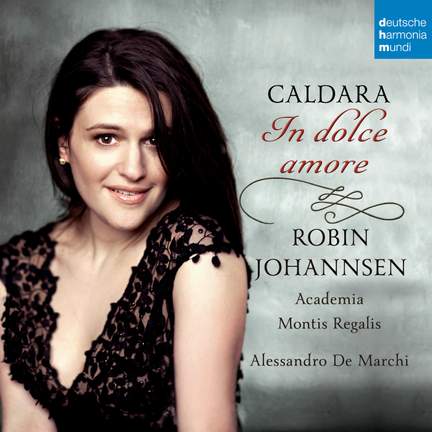
Academia Montis Regalis and Alessandro De Marchi accompany with robust directness or lighter delicacy as required, and Johannsen's versatile singing helps to reveal an enriching glimpse of Caldara's...
Caldara: In dolce amore
All the arias and cantatas on this album are world premiere recordings.
Robin Johannsen (soprano)
Academia Montis Regalis, Alessandro De Marchi
Purchase product
Academia Montis Regalis and Alessandro De Marchi accompany with robust directness or lighter delicacy as required, and Johannsen's versatile singing helps to reveal an enriching glimpse of Caldara's...
About
CANTATAS AND OPERAS – the twin pillars of secular vocal music of the baroque period. Few composers – though there are some notable exceptions – eschewed these genres if only because a set of cantatas, engraved or copied professionally and strategically dedicated, could be a comparatively inexpensive starting point for a career while opera lured with prospects of fame and fortune.
The Venetian-born Antonio Caldara (1670–1736) certainly was no exception. His set of twelve cantatas (Op. 3) appeared in 1699; his operas had been staged in theatres in Venice before his move to the court at Mantua in 1700. But with his appointment as maestro da cappella to Francesco Maria Ruspoli, prince of Cerveteri, in Rome from mid-1709 and then as vice-Kapellmeister to the imperial court at Vienna from June 1716, he encountered environments that required intense concentration on the cantata in one and on opera in the other.
In the seven years up to his departure for Vienna Caldara supplied Ruspoli with some 200 cantatas – but no more than three operas. The explanation lies in the ‘conversazioni’ that Ruspoli held in his palazzo on most Sundays throughout the year. At these, eminent clergy and diplomats, cognoscenti of the arts and friends of Ruspoli would hear their host’s small instrumental ensemble and some of his singers in new cantatas from his immensely prolific maestro. Nearly all of these are for soprano or contralto voice and most have a sequence of recitative – aria – recitative – aria. Many begin with an ‘introduzione’ comprising of two well-contrasted allegro movements. ‘Introduzioni’ and arias alike are scored for 3 strings (two violins and a bass line) or unison violins and continuo. Six arias of these three cantatas are intimate rather than grandiose, whether in their overall dimensions, slender accompaniments or small-scale musical ideas, and above all in their texts that deal with personal experiences of love: cruel, unrequited, possessive, delightfully painful, or sweet.
Contents and tracklist
Awards and reviews
 Awards Issue 2014
Academia Montis Regalis and Alessandro De Marchi accompany with robust directness or lighter delicacy as required, and Johannsen's versatile singing helps to reveal an enriching glimpse of Caldara's virtues.