Orff: Carmina Burana
Peter Binder (baritone), Maria Venuti (soprano), Ulf Kenklies (tenor)
NDR Chor, Niedersächsische Staatsorchester Hannover, NDR Sinfonieorchester, Hamburg Boys Choir, Hamburger Knabenchor, Günter Wand
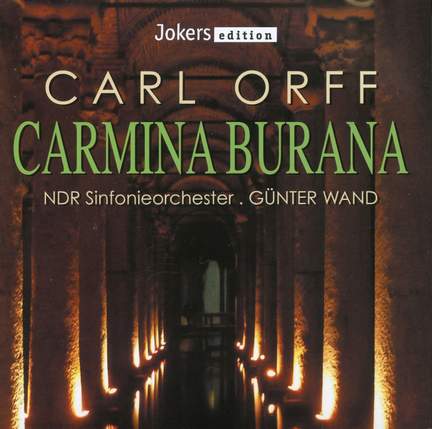
Orff: Carmina Burana
Peter Binder (baritone), Maria Venuti (soprano), Ulf Kenklies (tenor)
NDR Chor, Niedersächsische Staatsorchester Hannover, NDR Sinfonieorchester, Hamburg Boys Choir, Hamburger Knabenchor, Günter Wand
Purchase product
About
Ever since being in a position to decide for himself, Günter Wand never conducted works he could not identify with fully, whether it be old or new music. That integrity was perhaps what earned him the special trust and enduring loyalty of audiences during his 28 years as music director of the Gürzenich in Cologne and his almost 20 years as head and honorary conductor of the NDR Symphony Orchestra in Hamburg.
Throughout his career, that approach enabled Wand to include music of the twentieth century in his programmes – even unwieldy works – without unduly exasperating his audiences. There was no danger of doing that with Carmina Burana, however. The music had such immediate appeal that it became the sensation of the 1950s and 1960s and catapulted Carl Orff into the ranks of the most frequently performed living composers.
For those familiar only with Günter Wand’s interpretations of the great Classical and Romantic repertoire in latter years, it may come as a surprise that he of all people developed such an attachment to Carmina Burana, music slated as 'primitive' by protagonists of the Darmstadt school and disdainful critics alike.
Undaunted, Wand performed the powerful choral work in all four times in Cologne and Hamburg after 1955, seeing it as being just as indispensable a part of contemporary music as the works of Schoenberg, Webern or Messiaen, and treating it correspondingly.
At the 'extra-musical' level and quite apart from Carmina Burana, the texts of which are from the German Middle Ages, Wand was drawn to Carl Orff’s Mediterranean humanism, to the way Orff had returned to Latin as the universal language and later to Ancient Greek in the primal dramas of Sophocles and Aeschylus. For both Orff and Wand, the humanistic values of the classical Greeks and Romans had provided a means of consolidating their own attitudes in the dark years of the Nazi regime. Even the erotic poetry of Catullus served them as an alternative to a brutal present. Was it really a coincidence that Carl Orff composed his choric 'Catulli carmina' using poems by Catullus in 1943 and, just a few years later, Günter Wand took the same Latin texts for his concertino 'Odi et amo' for high coloratura soprano and twenty solo instruments?
Contents and tracklist
- NDR Chor, Niedersächsische Staatsorchester Hannover, NDR Sinfonieorchester
- Günter Wand
- Peter Binder
- Hamburg Boys Choir, NDR Chor, Niedersächsische Staatsorchester Hannover, NDR Sinfonieorchester
- Günter Wand
- Maria Venuti, Ulf Kenklies, Peter Binder
- Niedersächsische Staatsorchester Hannover, NDR Sinfonieorchester, NDR Chor, Hamburger Knabenchor
- Günter Wand
- Peter Binder, Ulf Kenklies
- Niedersächsische Staatsorchester Hannover, NDR Sinfonieorchester, Hamburger Knabenchor
- Günter Wand
- Maria Venuti, Peter Binder, Ulf Kenklies
- Hamburger Knabenchor, Niedersächsische Staatsorchester Hannover, NDR Sinfonieorchester, NDR Chor
- Günter Wand
- Maria Venuti
- Niedersächsische Staatsorchester Hannover, NDR Sinfonieorchester
- Günter Wand
- NDR Chor, Niedersächsische Staatsorchester Hannover, NDR Sinfonieorchester
- Günter Wand