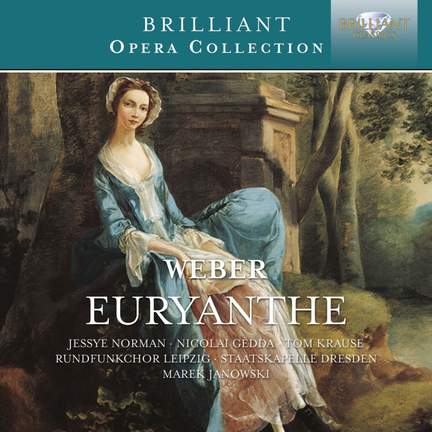
Weber: Euryanthe
Siegfried Vogel (König Ludwig VI), Nicolai Gedda (Adolar), Jessye Norman (Euryanthe), Tom Krause (Lysiart), Rita Hunter (Eglantine), Renate Krahmer (Bertha), Harald Neukirch (Rudolf)
Staatskapelle Dresden & Rundfunkchor Leipzig, Marek Janowski
The only commercial recording of this interesting opera there has ever been. Norman and Hunter give great performances.
Weber: Euryanthe
Siegfried Vogel (König Ludwig VI), Nicolai Gedda (Adolar), Jessye Norman (Euryanthe), Tom Krause (Lysiart), Rita Hunter (Eglantine), Renate Krahmer (Bertha), Harald Neukirch (Rudolf)
Staatskapelle Dresden & Rundfunkchor Leipzig, Marek Janowski
Purchase product
The only commercial recording of this interesting opera there has ever been. Norman and Hunter give great performances.
About
A careful blend of recitative, arioso and set piece, ‘Euryanthe’ was Carl Maria von Weber’s second opera, first performed in 1823 (two years after the premiere of Der Freischütz) and based on an early 13th century French romance with a libretto by Helmina von Chézy - the eccentric author of Schubert’s five-act ‘Rosamunde’. The work is largely based on the then common opera theme of a husband driven to test his wife’s fidelity. Lysiart, Adolar’s secret rival, boasts that he can lead the latter’s betrothed Euryanthe astray - a claim to which each reacts by staking all his possessions on the outcome. Lysiart appears to have triumphed when Eglantine, jealously in love with Adolar, manages to unlock from Euryanthe a secret concerning Adolar’s dead sister, who will not find rest until the ring from which she drank poison is wet with tears; Adolar, distraught, abandons Euryanthe and gives up all his possessions.
Things take a turn for the better, however, when Eglantine’s betrayal is uncovered by the king and his hunting party, who stumble upon an exhausted Euryanthe after she has just saved Adolar from a huge serpent. Alleging that Euryanthe has died, the king guilt-trips Eglantine at the ensuing peasant wedding into confessing her crime, whereupon she is fatally stabbed by an enraged Lysiart. Adolar is crazed with grief, but at this moment Euryanthe enters and the two are happily reunited.
Rarely staged because of its weak libretto, ‘Euryanthe’ is nevertheless a groundbreaking work due to its repeated use of chromaticism for depicting evil characters – Weber was well ahead of his time in this respect, as music history would have to wait another 40 years before Wagner pursued the ‘dissolution of tonality’ on a similar scale in ‘Tristan und Isolde’. This recording, made in 1974, features a stellar cast (Nicolai Gedda and Jessye Norman sing the roles of Adolar and Euryanthe respectively) and is directed by esteemed Polish-born conductor Marek Janowski.
Contents and tracklist
- Siegfried Vogel (soloist), Nicolai Gedda (soloist), Tom Krause (soloist), Jessye Norman (soloist), Rita Hunter (soloist), Harald Neukirch (soloist)
- Staatskapelle Dresden, Leipzig Radio Choir, Rundfunkchor Berlin
- Marek Janowski, Horst Neumann
- Tom Krause (soloist), Rita Hunter (soloist), Nicolai Gedda (soloist), Jessye Norman (soloist), Siegfried Vogel (soloist)
- Staatskapelle Dresden, Leipzig Radio Choir
- Marek Janowski, Horst Neumann
- Jessye Norman (soloist), Nicolai Gedda (soloist), Siegfried Vogel (soloist), Renate Krahmer (soloist), Harald Neukirch (soloist), Rita Hunter (soloist), Tom Krause (soloist)
- Staatskapelle Dresden, Leipzig Radio Choir
- Marek Janowski, Horst Neumann
Awards and reviews
 January 2014
The only commercial recording of this interesting opera there has ever been. Norman and Hunter give great performances.