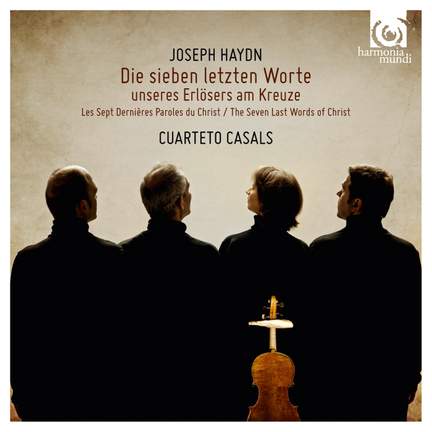
Haydn: String Quartet, Op. 51 'Seven Last Words'
Cuarteto Casals
Awards:
-
Gramophone Magazine, June 2014, Editor's Choice

Using Classical bows, the variety of nuance and colour these players derive from gradations of vibrato and bow pressure alone constitutes a masterclass in quartet playing. Yet it is the sheer...
Haydn: String Quartet, Op. 51 'Seven Last Words'
Cuarteto Casals
Purchase product
Awards:
-
Gramophone Magazine, June 2014, Editor's Choice
Using Classical bows, the variety of nuance and colour these players derive from gradations of vibrato and bow pressure alone constitutes a masterclass in quartet playing. Yet it is the sheer...
About
Haydn wrote his 'Seven Last Words' in 1786/87 for Good Friday devotions in Cádiz. Although the custom in Cádiz was to perform an oratorio, Haydn's brief was in fact to write seven movements for orchestra alone, each creating a mood inspired by one of the sayings attributed to the dying Christ. He chose to frame them with a further slow movement called ‘Introduzione’ and a concluding Presto entitled ‘Il Terremoto’, intended to depict the earthquake that occurred after Christ’s death (Matthew 27:51).
This purely instrumental ‘oratorio’ consisting of seven contemplative slow movements was by no means an easy task; but the outcome was a work of sublime nobility, which in Haydn’s own transcription for string quartet has enjoyed unfailing popularity ever since.
It is entirely appropriate that this recording of Haydn’s 'Seven Last Words of Christ' should be performed by the Cuarteto Casals, for the work represents one of the few surviving traces of the composer’s flourishing relationship with Spain, where his music seems quickly to have become as popular as it was in France and Britain. There is footage of excerpts from the 'Seven Last Words' on our harmonia mundi YouTube channel recorded at Oratorio de Santa Cueva, Cadiz, the place for which the work was orginally written.
Contents and tracklist
Spotlight on this release
-
Music for Holy Week
16th Apr 2014
A brief round-up of recent releases focusing on Passiontide and Easter.

Awards and reviews
-
Gramophone MagazineJune 2014Editor's Choice
 June 2014
Using Classical bows, the variety of nuance and colour these players derive from gradations of vibrato and bow pressure alone constitutes a masterclass in quartet playing. Yet it is the sheer intensity and range of expression that transfixes the ear...Truly a revelation.
 13th April 2014
This performance combines devotional gravity, a refined sense of drama and beautifully precise and pure playing.
 June 2014
The key quality with the Cuarteto Casals is consistent poise - or, rather, poise coupled with a complete understanding of Haydn's textural colouring...The players use a minimal amount of vibrato, reserving it for emotional effect rather than as a standard tool.
 May 2014
Anyone who has encountered previous releases from this group will know what to expect: seriously lean textures, an austere avoidance of vibrato leading to a certain wiriness of sound, an extraordinary clarity of detail and attention to nuance, stark contrasts of staccato and legato, an utter lack of sentimentality that at the same time allows a high degree of expressivity.
 9th March 2014
The Casals bring a rapt spiritual intensity and high emotional drama to the piece.