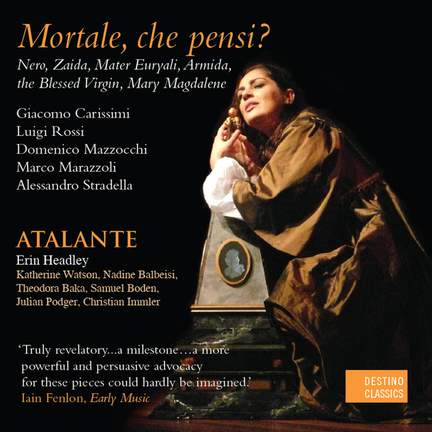
Mortale, che pensi?
Reliquie di Roma: III
Atalante, Erin Headley
I have never heard accompanying continuo played so dramatically or for that matter such committed singing in this repertoire. These are dramatized performances. Not only have these singers and...
Mortale, che pensi?
Reliquie di Roma: III
Atalante, Erin Headley
Purchase product
I have never heard accompanying continuo played so dramatically or for that matter such committed singing in this repertoire. These are dramatized performances. Not only have these singers and...
About
Erin Headley’s award-winning ensemble ATALANTE is named in honour of Leonardo da Vinci’s friend and pupil Atalante Migliorotti, who invented the lirone in 1505. That magic and hauntingly beautiful bowed instrument has been Erin Headley’s domain since 1980, through an astonishing number of performances and recordings that have been acclaimed worldwide. In the 17th century the lirone was associated with the lament, a genre that first appeared during the generation of Monteverdi, reached its culmination in Rome, and has been Atalante’s main specialization.
Since 2009 Atalante has made numerous appearances in Europe, the UK and the US. In 2014, with Erin Headley as music director, the group will be the featured performers in a production of Luigi Rossi’s Orfeo at the Galway Festival, while 2015 will see a tour of the US and Canada, and performances in Istanbul, Stockholm and Bratislava.
Contents and tracklist
- Atalante
- Atalante
- Atalante
- Atalante
- Atalante
- Atalante
- Atalante
- Atalante
- Atalante
- Atalante
- Atalante
- Atalante
- Atalante
- Atalante
- Atalante
- Atalante
Awards and reviews
 12th June 2014
I have never heard accompanying continuo played so dramatically or for that matter such committed singing in this repertoire. These are dramatized performances. Not only have these singers and players brought this forgotten music to light they are performing it surely as it must have been done four hundred years ago: to move the audience to tears and to bring the story to life.