Schumann: Complete Organ Music
Roberto Marini (organ)
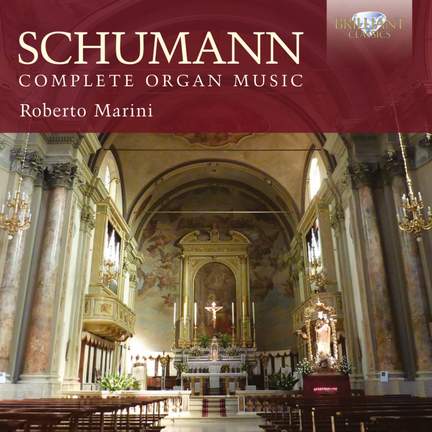
Not all top-drawer Schumann, this music originally written for pedal piano nevertheless includes several gems. The Schumannesque hallmarks of the Four Sketches are well captured on an Italian...
Schumann: Complete Organ Music
Roberto Marini (organ)
Purchase product
Not all top-drawer Schumann, this music originally written for pedal piano nevertheless includes several gems. The Schumannesque hallmarks of the Four Sketches are well captured on an Italian...
About
Robert Schumann is probably best known for his copious amount of piano works and lieder – music that, fuelled by vivid imaginings and unfettered emotions, represents one of the highest expressions of the Romantic spirit. It shouldn’t be forgotten, however, that the composer also wrote masterly works for the organ, an instrument which interested him only occasionally but which he praised in his Rules for House and Life (1850): “If you pass near a church and you hear the organ playing, go inside and listen… Never waste an opportunity to practise the organ: there is no other instrument able so swiftly to dispense with all that is impure and imprecise, both in the music itself and in the manner of playing it.”
It was Schumann’s deep admiration for J.S. Bach that led him to a detailed study of counterpoint – one which, together with his encounter with the Pedalflügel (a piano with a pedalboard), led him to compose the three groups of works comprising this release. Given that the pedal piano is now all but obsolete, the conventional organ suffices more than adequately for this type of repertoire, and the Mascioni Organ of Pontevico – inaugurated in 2009 and combining traditional elements with innovative design concepts – is a particularly fine specimen on which to play it. Roberto Marini, one of Italy’s most accomplished organists and whose repertoire betrays his particular affinity with the Romantic and late‐Romantic oeuvre (career highlights include a complete Reger cycle performance) begins his recital with the Six Studies Op.56, works written in strictly canonic form and which reveal the diverse aspects of Schumann’s musical personality. The Four Sketches Op.58, pieces of poetic character, close to the style of chamber music, follow, leading to the final and crowning work of the set: the Six Fugues on BACH, a personal tribute the composer’s inspiration and the first important composition in musical history to be based on the theme of Bach’s name.
Contents and tracklist
Spotlight on this release
-
An error occurred.
Try watching this video on www.youtube.com, or enable JavaScript if it is disabled in your browser.
Awards and reviews
 July 2014
Not all top-drawer Schumann, this music originally written for pedal piano nevertheless includes several gems. The Schumannesque hallmarks of the Four Sketches are well captured on an Italian organ.