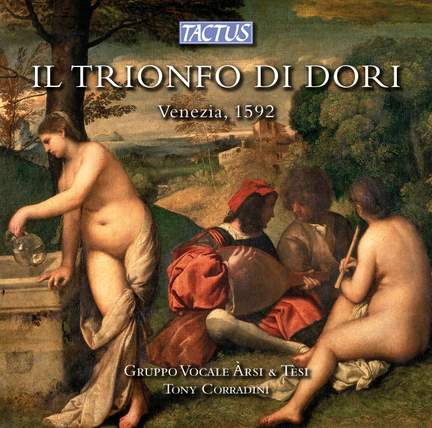
Special offer. Il Trionfo di Dori
Venezia, 1592
Gruppo Vocale Arsi & Tesi, Tony Corradini
Special offer. Il Trionfo di Dori
Venezia, 1592
Gruppo Vocale Arsi & Tesi, Tony Corradini
Purchase product
About
1592 was the year in which Il Trionfo di Dori was printed. The dedicatee, Leonardo Sanudo, a Venetian nobleman belonging to one of the most ancient families of that city, had asked twenty-nine authors to compose a poem, then had asked twenty-nine musicians to compose a madrigal on each of those texts.
The cultural operation carried out with Il Trionfo was characterised by an unusual relationship between the figures that typically took part in publishing activities - patron, poet, composer, printer - who normally, though interacting, worked independently: here, as in other similar projects, Sanudo also involved a network of friendships with aristocratic amateur poets and musicians.
This collection of madrigals is characterised by several aspects that must have made its preparation particularly laborious: it was ordered for a specific event; it was assembled in two chronologically different stages (first the poems, then the madrigals); and each piece, as we have already mentioned, was entrusted to a different poet and a different composer.
Il Trionfo di Dori, which is set in Arcadia - the place of the golden age, a sort of pagan earthly paradise - describes several idyllic scenes, in which a mythical past is merged with a peaceful pastoral world. Each piece is closed by the words “Viva la bella Dori!” (“Long live fair Dori!”) - almost a greeting to the bride - and this is the element that unifies the collection. Dori, the lovely sea nymph, daughter to Ocean in classical mythology, is the name that hints at the woman to whom the work was dedicated, Elisabetta Giustinian.
Contents and tracklist
- Gruppo Vocale Àrsi & Tèsi
- Tony Corradini
- Gruppo Vocale Àrsi & Tèsi
- Tony Corradini
- Gruppo Vocale Àrsi & Tèsi
- Tony Corradini
- Gruppo Vocale Àrsi & Tèsi
- Tony Corradini
- Gruppo Vocale Àrsi & Tèsi
- Tony Corradini
- Gruppo Vocale Àrsi & Tèsi
- Tony Corradini
- Gruppo Vocale Àrsi & Tèsi
- Tony Corradini
- Gruppo Vocale Àrsi & Tèsi
- Tony Corradini
- Gruppo Vocale Àrsi & Tèsi
- Tony Corradini
- Gruppo Vocale Àrsi & Tèsi
- Tony Corradini
- Gruppo Vocale Àrsi & Tèsi
- Tony Corradini
- Gruppo Vocale Àrsi & Tèsi
- Tony Corradini
- Tony Corradini
- Gruppo Vocale Àrsi & Tèsi
- Gruppo Vocale Àrsi & Tèsi
- Tony Corradini