Franck, C: L'Organiste
Jan von Busch (organ)
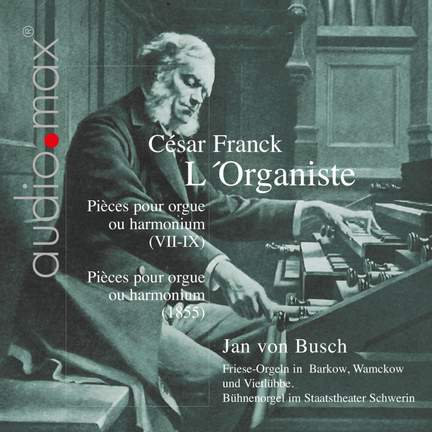
Franck, C: L'Organiste
Jan von Busch (organ)
Purchase product
About
Passow, Hanstorf, Alt Bukow, Bülow, Vietlübbe, Biblow – the village churches of Mecklenburg- Vorpommern are home to carefully maintained organ rarities in the French style. Friedrich Friese, a highly gifted pupil of Aristide Cavaillé-Coll, built these instruments in the nineteenth century and did so with great care and individuality for each church. These organs equipped with only a few stops have not yet been documented in recorded form. Jan von Busch from Rostock now scores a first with a CD featuring César Franck’s cycle L’Organiste.
Friedrich Friese spent a mere two years with his mentor in Paris, but this short time marked him for life. From now on each of his more than one hundred organs followed Cavaillé-Coll’s principles. Most of the instruments from Friese’s workshop had only four to eight stops with a pedal attachment, but each of them forms a musical microcosm all of its own.
The French organ literature of the nineteenth century is rich in works for small instruments. Not all the compositions are as demanding as the cycles from L’Organiste including Magnificat settings of high art. This late work by César Franck is a tour of all the minor and major keys. Three major and three minor keys are sophisticatedly linked in each cycle. At the conclusion a short “Amen” is followed each time by a longer final piece assimilating the most important motifs from the preceding versets.
The Hamburg native Jan von Busch used the initial years of his career as a music and religion teacher in Schwerin to investigate Mecklenburg’s rich organ landscape. He focused in particular on artistic occupation with the factors represented by the historical instrument and the church space in which it is found. It is thus only natural that he has selected an organ with a disposition ideally suited to each piece for each part of César Franck’s collection. Passow, Hanstorf, Alt Bukow, Bülow, Vietlübbe, Biblow – the village churches of Mecklenburg- Vorpommern are home to carefully maintained organ rarities in the French style. Friedrich Friese, a highly gifted pupil of Aristide Cavaillé-Coll, built these instruments in the nineteenth century and did so with great care and individuality for each church. These organs equipped with only a few stops have not yet been documented in recorded form. Jan von Busch from Rostock now scores a first with a CD featuring César Franck’s cycle L’Organiste.
Friedrich Friese spent a mere two years with his mentor in Paris, but this short time marked him for life. From now on each of his more than one hundred organs followed Cavaillé-Coll’s principles. Most of the instruments from Friese’s workshop had only four to eight stops with a pedal attachment, but each of them forms a musical microcosm all of its own.
The French organ literature of the nineteenth century is rich in works for small instruments. Not all the compositions are as demanding as the cycles from L’Organiste including Magnificat settings of high art. This late work by César Franck is a tour of all the minor and major keys. Three major and three minor keys are sophisticatedly linked in each cycle. At the conclusion a short “Amen” is followed each time by a longer final piece assimilating the most important motifs from the preceding versets.
The Hamburg native Jan von Busch used the initial years of his career as a music and religion teacher in Schwerin to investigate Mecklenburg’s rich organ landscape. He focused in particular on artistic occupation with the factors represented by the historical instrument and the church space in which it is found. It is thus only natural that he has selected an organ with a disposition ideally suited to each piece for each part of César Franck’s collection.
Contents and tracklist
- Jan von Busch
- Jan von Busch
- Jan von Busch
- Jan von Busch