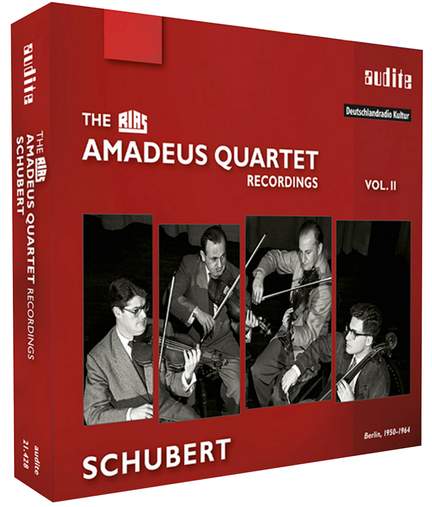
Special offer. The RIAS Amadeus Quartet Recordings Vol. 2: Schubert
Berlin 1950-64
Amadeus Quartet
there is a wholly communicative interplay at work and a very special sound world that the foursome captures. It elevates these performances, and their studio confreres, to the status of being...
Special offer. The RIAS Amadeus Quartet Recordings Vol. 2: Schubert
Berlin 1950-64
Amadeus Quartet
Purchase product
there is a wholly communicative interplay at work and a very special sound world that the foursome captures. It elevates these performances, and their studio confreres, to the status of being...
About
Following the release of Beethoven String Quartets with the Amadeus Quartet, Audite now presents the second volume in this recording series featuring works by Franz Schubert.The trademarks of the world-famous string quartet were a beautiful sound and technical perfection; in 1975 the famous German critic Joachim Kaiser confirmed that the Amadeus Quartet was „still the best string quartet in the world". The ensemble's fame had evolved, alongside many concerts and world-wide tours, thanks to its numerous recordings on disc. Less well-known, however, is the fact that the Amadeus Quartet also made many radio recordings. For nearly 20 years, from 1950 until 1969, the Amadeus Quartet regularly travelled to the Berlin RIAS studios. Here, a whole host of recordings was made, reflecting not only the quartet's core repertoire, but also novelties - works that had previously not been performed by the Amadeus Quartet. In the audite series 'The RIAS Amadeus Quartet Recordings', the majority of these recordings are released in six thematically assembled boxed CD sets. Alongside classical composers led by Haydn, Mozart and Beethoven, from the outset the music of Franz Schubert formed a pillar of the Amadeus Quartet's repertoire. Not only did the musicians devote themselves to the three great quartets - the 'Rosamunde', 'Death and the Maiden' and the String Quartet in G major - but they also played some of the early quartets on a regular basis.The Amadeus Quartet finds a particular quality for each of the quartets and thus does justice to the requirements and the content of the music. The early quartets are not overloaded with a "big sound", but are played with a light and lean timbre. For the 'Rosamunde' Quartet, the ensemble presents an interpretation characterised by an inner calm and, at the same time, a piercing intensity. 'Death and the Maiden' reveals precise preparation resulting in a homogenous balance. The underlying sense of drama of the G major String Quartet, Schubert's final quartet, is emphasised by great contrasts. The very early radio recordings of 1950 and 1951 in particular are characterised by impetuous turbulence and youthful exuberance, which are transformed in the later recordings into classical balance, perfection and a beautiful tone. These radio recordings made by the Amadeus Quartet add to, and widen, the view of the astonishing and successful history of this ensemble.
Contents and tracklist
- Amadeus Quartet
- Recorded: 6 October 1954
- Recording Venue: Siemensvilla, Berlin-Lankwitz
- Amadeus Quartet
- Recorded: 19 November 1951
- Recording Venue: Siemensvilla, Berlin-Lankwitz
- Amadeus Quartet
- Recorded: 5 December 1964
- Recording Venue: Siemensvilla, Berlin-Lankwitz
- Amadeus Quartet
- Recorded: 8 February 1956
- Recording Venue: Siemensvilla, Berlin-Lankwitz
- Amadeus Quartet
- Recorded: 9 June 1950
- Recording Venue: Siemensvilla, Berlin-Lankwitz
Awards and reviews
 9th April 2014
there is a wholly communicative interplay at work and a very special sound world that the foursome captures. It elevates these performances, and their studio confreres, to the status of being amongst the finest Schubert quartet performances of the 1950s.
 February 2014
These players penetrate well below the music’s surface in the earliest recording (D887, from 1950), shaping the lines to reflect both poetry and youthful exuberance, achieving commendable blend and balance and capturing the work’s underlying sense of drama with sharply graded contrasts. Roughness occasionally results, particularly in the turbulent outer movements, but their accounts of the slow movement and scherzo are delightful.