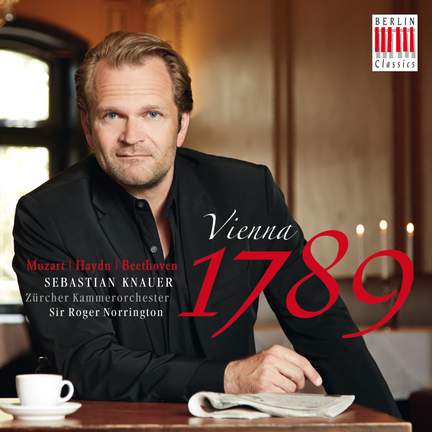
Vienna 1789: Sebastian Knauer
Sebastian Knauer (piano)
Zürcher Kammerorchester, Sir Roger Norrington
Norrington conducts perspicaciously, eschewing throughout the didacticism and emotional disengagement that has so often blocked his inner vision. Sebastian Knauer complements, never circumscribed...
Vienna 1789: Sebastian Knauer
Sebastian Knauer (piano)
Zürcher Kammerorchester, Sir Roger Norrington
Purchase product
Norrington conducts perspicaciously, eschewing throughout the didacticism and emotional disengagement that has so often blocked his inner vision. Sebastian Knauer complements, never circumscribed...
About
The distant Revolution?
Vienna 1789? That was the year of Paris, the storming of the Bastille and the French Revolution. The Hamburg pianist Sebastian Knauer makes it clear on his new CD that there were things happening in Vienna that year too. The great Viennese Classical composers were busy writing music that shows how fast things were moving at that time. Wolfgang Amadeus Mozart composed his last Piano Concerto, K595, while his "successor" Ludwig van Beethoven was writing the first of his piano concertos, which we now know as his Second Piano Concerto, op. 19 – both in B flat major and both with interesting features to contrast and compare. It would be a mistake to look for the spirit of the Revolution in these works; that wind of change was not yet blowing through Europe. The ideas of the Enlightenment were already fermenting in people's minds, however. So it is no accident that this musical succession should involve two composers who illustrate in their careers the transition from the professional musicianship of Court lackeys to the amateur music‐making of the bourgeoisie.
Joseph Haydn's Piano Sonata in E flat major, Hob.XVI:49 was also written in the year of the Revolution and offers instructive proof that the eldest of the Viennese Classical triumvirate is often closer to Beethoven than to Mozart. For that reason, it is convincingly placed in the middle of this programme. As Sebastian Knauer shows, the customary serial arrangement of the three composers all too soon conceals the parallel developments of that seminal period around 1789. Sebastian Knauer has been able to call upon reliable partners for his latest recording: in the Zurich Chamber Orchestra under Sir Roger Norrington – following their highly acclaimed joint project "Bach & Sons" – he has found kindred spirits who endorse his commitment to the historically informed approach on modern instruments. Their success is audible: when popular classics are so intelligently combined and compellingly presented as they are here, we suddenly (and refreshingly!) hear familiar works with new ears.
Contents and tracklist
Awards and reviews
 December 2013
Norrington conducts perspicaciously, eschewing throughout the didacticism and emotional disengagement that has so often blocked his inner vision. Sebastian Knauer complements, never circumscribed but never violating artistic integrity either...Knauer does Mozart proud. Beethoven too.