Special offer. Fazil Say: Symphonies Nos. 2 & 3
Carolina Eyck (theremin), Bülent Evcil (bass flute), Çaatay Akyol (bass recorder), Aykut Köselerli (percussions) & Fazil Say (piano)
Borusan Istanbul Philharmonic Orchestra, Gürer Aykal
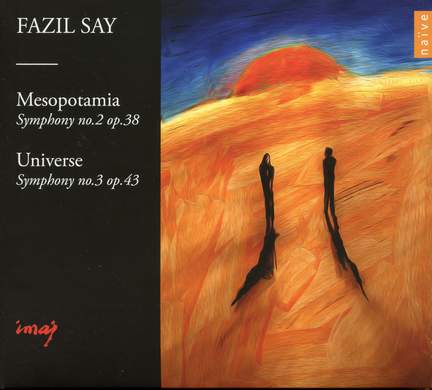
In these colourful, eclectic, dramatic works...Say impressively flexes his compositional muscles and pianistic dexterity.
Special offer. Fazil Say: Symphonies Nos. 2 & 3
Carolina Eyck (theremin), Bülent Evcil (bass flute), Çaatay Akyol (bass recorder), Aykut Köselerli (percussions) & Fazil Say (piano)
Borusan Istanbul Philharmonic Orchestra, Gürer Aykal
Purchase product
In these colourful, eclectic, dramatic works...Say impressively flexes his compositional muscles and pianistic dexterity.
About
1 CD + DVD
This is the fourth recording of works composed by Fazil Say, following successful 'Black Earth' released in 2003, '1001 Nights in the Harem' released in 2009 and 'Istanbul-Hezarfen' released last year.
“In constructing the Mesopotamia Symphony, Fazil Say attempts to narrate the story of the present day Middle East as well as the culture of Mesopotamia throughout history. It is a land which cradles within it the history of the Sumerians, the culture and beliefs of Assyria, Babylon and Urartu. From there we move to our own day and the contemporary issues facing the Middle East and Turkey; the Kurdish problem, the never-ending wars, terror. In the words of the philosophers, this is a “culture of death.” The region known as Mesopotamia is known as the cradle of culture and humanity; so many things which define us as human being emerged here thousands of years ago. There is a particular “Opera of Instruments” technique prevalent in Say’s symphony. The composer narrates the symphony through two solo instruments, the bass flute and the bass recorder, which represent two children, or more specifically two brothers. These two instruments symbolically and simply represent the “innocent human being.” Tragically, one of the brothers will be shot. The Theremin on the other hand is the symbolic “Angel,” the protector of Mesopotamia in its harrow-ing drama. For the composer, the Mesopotamia Symphony signifies a call to peace.”
“The Universe symphony is created from astronomic as opposed to astrologic data. Astronomic data is of course directly dependent on changes in current science and in this work, the composer is using scientific data available in 2012. In this sense, the Big Bang, the expansion of the universe, the contention that Gliese 581 g may be an earth-like planet, the supposition that the God Particle may be found after analysis of dark matter – all of this may be deemed to contain no truth by the future world of science.
Meanings of the harmonic construction
1- Nature: Major tonality
2- Humans: Minor tonality
3- Chaos: Atonality
4- Frequency of the void of the universe: D Note”
Contents and tracklist
- Carolina Eyck (theremin), Bulent Evcil (bass flute), Cagatay Akyol (bass recorder), Fazil Say (piano)
- Borusan Istanbul Philharmonic
- Gurer Aykal
- Recorded: 14 December 2012
- Recording Venue: Istanbul Lutfi Kırdar Convention and Exhibition Centre, Istanbul, Turkey
- Carolina Eyck (theremin), Aykut Koselerli (percussion)
- Borusan Istanbul Philharmonic
- Gurer Aykal
- Recorded: 16 December 2012
- Recording Venue: Istanbul Lutfi Kırdar Convention and Exhibition Centre, Istanbul, Turkey
Awards and reviews
 February 2014
In these colourful, eclectic, dramatic works...Say impressively flexes his compositional muscles and pianistic dexterity.