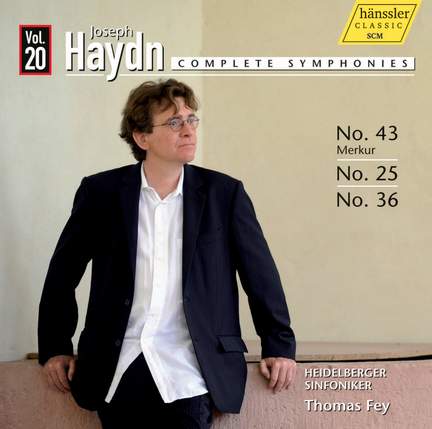
Special offer. Haydn - Complete Symphonies Volume 20
Heidelberg Symphony Orchestra, Thomas Fey
Fey is less concerned with driving it hard and accentuating Haydn's characteristic nervy energy, taking the first movement more gently than in many other recordings...[in No. 36] Haydn lays...
Special offer. Haydn - Complete Symphonies Volume 20
Heidelberg Symphony Orchestra, Thomas Fey
Purchase product
Fey is less concerned with driving it hard and accentuating Haydn's characteristic nervy energy, taking the first movement more gently than in many other recordings...[in No. 36] Haydn lays...
About
The 20th installment in Thomas Fey and the Heidelberg Symphony Orchestra’s recordings of the complete symphonies of Haydn.
International critical acclaim ranks Fey’s interpretations among the best.
Performances that balance historical performance practice while using modern strings and historical brass instruments.
The symphonies presented here date from the years 1762 and 1771. While scored only for strings and pairs of two oboes and horns with a bassoon added, Haydn manages to delight us with numerous surprising ideas: Symphony No. 25 has no slow movement, while No. 36 suddenly becomes a concerto movement with solo violin and solo cello and No. 43 storms forward with relentlessly driving rhythms... You can clearly hear that Haydn was a great experimenter and a great entertainer. Thomas Fey’s interpretations make all this clearly heard.
Contents and tracklist
- Heidelberg Symphony Orchestra
- Thomas Fey
- Recorded: 15-18 January 2013
- Recording Venue: Internationale Naturhomakademie, Bad Durkheim, Germany
- Heidelberg Symphony Orchestra
- Thomas Fey
- Recorded: 15-18 January 2013
- Recording Venue: Internationale Naturhomakademie, Bad Durkheim, Germany
- Heidelberg Symphony Orchestra
- Thomas Fey
- Recorded: 15-18 January 2013
- Recording Venue: Internationale Naturhomakademie, Bad Durkheim, Germany
Awards and reviews
 Awards Issue 2013
Fey is less concerned with driving it hard and accentuating Haydn's characteristic nervy energy, taking the first movement more gently than in many other recordings...[in No. 36] Haydn lays out a set of contrasting themes, and Fey and his Heidelbergers audibly revel in the symphonic argument