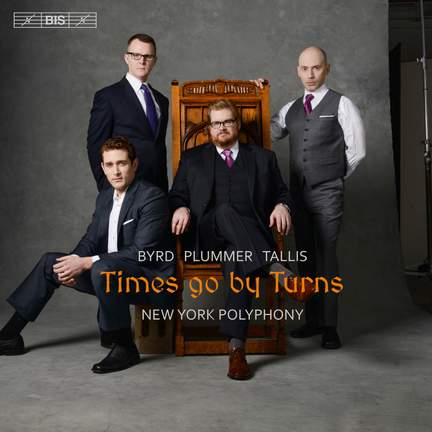
Times go by Turns
New York Polyphony
The ensemble is at its best in the new music, which they sing with a stylish flair, and the more homophonic passages of Tallis, which they unfailingly imbue with direction and purpose.
Times go by Turns
New York Polyphony
Purchase product
The ensemble is at its best in the new music, which they sing with a stylish flair, and the more homophonic passages of Tallis, which they unfailingly imbue with direction and purpose.
About
Taking its title from a poem by the sixteenth-century Jesuit martyr Robert Southwell, Times go by Turns comprises three masses composed during a period when the conditions for English Catholics – and Catholic composers – underwent radical change. Active at a time – the 15th century – when the Catholic Church flourished in England, John Plummer’s death roughly coincided with the ascension of the Tudors, a dynasty that would irreversibly alter religious traditions. As a consequence, the bulk of Plummer’s music was destroyed during the Reformation, the remainder surviving almost exclusively in sources from the continent. Born a century later than Plummer, Tallis witnessed the separation of England from the Catholic Church and his Mass for Four Voices displays a simple lyricism and economic use of polyphony which may well have been driven by liturgical necessity. Such constraints had grown even stronger by the end of the century, when his student and colleague William Byrd composed his own four-part Mass, intended for clandestine worship at a time when dissidents were dealt with by cruel means.
The vocal quartet New York Polyphony released endBeginning (BIS-1949) in 2012, a disc which focused on Franco-Flemish polyphony. Meeting with international acclaim, the ensemble’s first collaboration with BIS received top marks on website ClassicsToday.com and in the French magazine Diapason, as well as being included on the Best-of-2012 lists in The New Yorker and Time Out New York. While dedicated to the works of the great age of polyphony, New York Polyphony is also noted for its performances of contemporary music. For this disc the ensemble has commissioned two modern works, with Andrew Smith contributing a Kyrie – the movement which Tallis’ mass leaves out – and Gabriel Jackson providing the closing Ite missa est (‘The mass is ended’). The programme also includes one of the last compositions by Richard Rodney Bennett (1936–2012). A Colloquy with God, the setting of a poem by Sir Thomas Browne for four male voices, was dedicated to New York Polyphony.
Contents and tracklist
Awards and reviews
Early Music Today
The ensemble is at its best in the new music, which they sing with a stylish flair, and the more homophonic passages of Tallis, which they unfailingly imbue with direction and purpose.