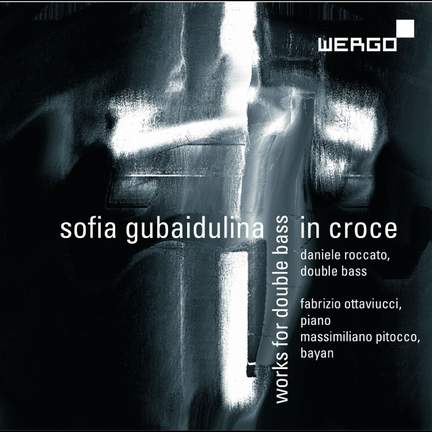
Gubaidulina: In Croce
works for double bass
Daniele Roccato (double bass), Fabrizio Ottaviucci (piano) & Massimiliano Pitocco (bayan)
By turns both ethereal and then confrontational, the work employs a vast range of tonal and instrumental effects, and the performance here by Daniele Roccato and Massimiliano Pitocco is impressive...
Gubaidulina: In Croce
works for double bass
Daniele Roccato (double bass), Fabrizio Ottaviucci (piano) & Massimiliano Pitocco (bayan)
Purchase product
By turns both ethereal and then confrontational, the work employs a vast range of tonal and instrumental effects, and the performance here by Daniele Roccato and Massimiliano Pitocco is impressive...
About
The double bass is the focus of four compositions by Sofia Gubaidulina, presented here in unique interpretations by Daniele Roccato, Fabrizio Ottaviucci and Massimiliano Pitocco. The compositions which were written and reviewed over a time span of over 40 years "are among the highlights in double bass literature: four gems of outstanding value every double bass player should learn to perform." (Roccato)
In 'Sonata' the double bass part is largely written in a traditional way. However, the performer can opt for various choices of fingering, positions and resonating chords according to personal preferences. Moreover, it is to be assumed that Gubaidulina also intended a specific gestural expressiveness of the double bass player to be part of the tonal result. In 'Pantomime' one immediately senses a certain theatricality which is evoked by melodic contours, dramatic pauses and dynamic progressions. Everything contributes to revealing the composer’s dramatic intention.
Gubaidulina originally composed her ten 'Preludes' for the cello. Later, she rearranged nine of these original compositions for double bass.
In 1975 Sofia Gubaidulina, Viktor Suslin and Vyacheslav Artyomov founded a group called 'Astreya' whose aim was to achieve new forms of improvisation by using either ancient or folk instruments. Against this backdrop, the composer used for her third version of 'In Croce' not only the double bass but also the bayan which is a sort of button accordion quite common in Russia at the beginning of the 20th century.
Contents and tracklist
- Daniele Roccato
- Daniele Roccato
- Daniele Roccato
- Daniele Roccato
Awards and reviews
 September 2013
By turns both ethereal and then confrontational, the work employs a vast range of tonal and instrumental effects, and the performance here by Daniele Roccato and Massimiliano Pitocco is impressive for its emotional and expressive concentration as much as for its technical accomplishment