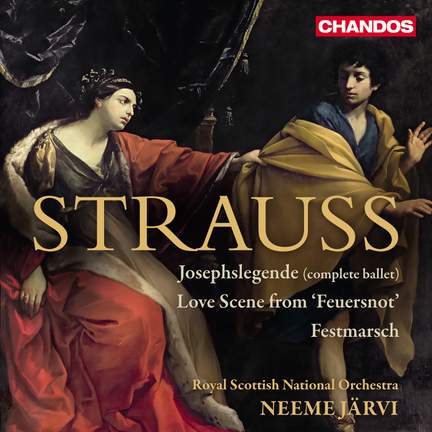
R. Strauss: Josephslegende
Royal Scottish National Orchestra, Neeme Järvi
Awards:
-
Presto Recording of the Week, 10th June 2013

there's some attractive lighter music at the ballet's core: Jarvi, his woodwind - first flute especially - and solo strings make the most of it. Some of the somberness with which Potiphar's...
R. Strauss: Josephslegende
Royal Scottish National Orchestra, Neeme Järvi
Purchase product
Awards:
-
Presto Recording of the Week, 10th June 2013
there's some attractive lighter music at the ballet's core: Jarvi, his woodwind - first flute especially - and solo strings make the most of it. Some of the somberness with which Potiphar's...
About
Josephslegende by Richard Strauss is based on the Biblical tale of the adventures of Joseph in Egypt after he has been sold into slavery by his brothers. Strauss started the work in June 1912. However, in a letter of 11 September, he confided that ‘Joseph isn’t progressing as quickly as I expected. The chaste Joseph himself isn’t at all up my street, and if a thing bores me I find it difficult to set it to music. This God-seeker Joseph – he’s going to be a hell of an effort!’ Quite characteristic for Strauss, he showed far more interest in the sexual elements of the story, in which Potiphar’s wife attempts to seduce Joseph and ends up committing suicide. The ballet was premiered at the Paris Opéra in May 1914, where it was presented as part of a triple bill alongside danced interpretations of Rimsky-Korsakov’s Sheherazade and Schumann’s Papillons.
Strauss’s opera Feuersnot (Trial by Fire) has been interpreted as a parody of Richard Wagner’s idea of ‘redemption through love’. The opera takes place during the Midsummer Festival, where lovers swear their fidelity by leaping through the flames of a bonfire. In the story, the main character, Kunrad, is attracted to Diemut, a young girl who rejects his advances, with dire consequences. In retaliation, he persuades a sorcerer to extinguish all the fires in the town, stating that the only way to restore them is via ‘the body of a virgin in heat’. The opera concludes with the Love Scene, recorded here, in which Diemut sacrifices her virginity to Kunrad in order to release the spell on the fires. At the time of its premiere in 1901, the strong sexual theme was quite disturbing to its audiences.
Also on this disc is the Festmarsch, Op. 1, his first published orchestral work, which Strauss wrote at the tender age of twelve. Five years later he approached the publisher Breitkopf & Härtel who initially refused to take it on. Only when the work’s dedicatee, Strauss’s uncle Georg Pschorr, indicated that he would pay for the printing costs himself did they relent. Strauss’s father launched the piece at a concert given by his amateur orchestra, Wilde Gung’l, in March 1881.
The works are performed by the Royal Scottish National Orchestra under Neeme Järvi, who in 2012 celebrated his thirty-year recording career with Chandos Records.
Contents and tracklist
- Neeme Järvi, Royal Scottish National Orchestra
- Recorded: 18-19 September 2012
- Recording Venue: Royal Concert Hall, Glasgow
Spotlight on this release
-
Neeme Järvi conducts Richard Strauss’s ballet, Josephslegende
10th Jun 2013
Strauss himself may have spoke slightingly of this work (commissioned by Sergei Diaghilev’s Ballets Russes in 1914), but Chris is won over by the range and combinations of orchestral colours, and Järvi’s carefully calculated tempos and tempo relationships.

Awards and reviews
-
Presto Recording of the Week10th June 2013
 September 2013
there's some attractive lighter music at the ballet's core: Jarvi, his woodwind - first flute especially - and solo strings make the most of it. Some of the somberness with which Potiphar's wife approaches the innocent's bed comes across well, too.
 August 2013
The RSNO under Neeme Jarvi perform it with aplomb and with plenty of colour derived from the massive palette of orchestration...The Love Scene from Feuersnot and the vigorous Festmarsch make for useful fill-ups.
 12th August 2013
All of [Järvi's tempi] sound, to my own ears at least, eminently danceable and suitable for a staged performance, just as they ought to be...Järvi’s is a very fine interpretation and performance, superbly moulded and played and extremely well recorded.
 10th June 2013
The Royal Scottish National Orchestra play this technically very difficult score magnificently, whilst Neeme Järvi creates real tension and nervous energy by his carefully calculated tempos and tempo relationships. Solos are well phrased and characterised, while orchestral balance is close on perfect...A really welcome addition then to anyone’s Strauss discography. Strongly recommended.
 16th June 2013
this is mature Strauss, brilliantly orchestrated in his glittering Frau ohne Schatten vein. Jarvi (pictured above) and the RSNO make the strongest possible case for a neglected work, and their makeweights...are rare collectibles for avid Straussians.
 4th July 2013
He offers a considered, low-key interpretation, ultra-refined in detail, scrupulously played, and particularly good when it comes to Strauss's depiction – sometimes described as awkward – of Joseph's chaste nobility.