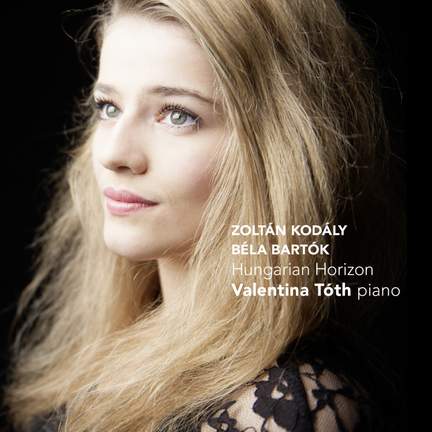
Hungarian Horizon: Valentina Tóth
Valentina Tóth (piano)
Toth's approach...is fresh and thoughtful. Her realization of the subtlest of Bartok's infinitely varied indications of touch and tempo are almost always persuasive...[her] perceptive interpretations...
Hungarian Horizon: Valentina Tóth
Valentina Tóth (piano)
Purchase product
Toth's approach...is fresh and thoughtful. Her realization of the subtlest of Bartok's infinitely varied indications of touch and tempo are almost always persuasive...[her] perceptive interpretations...
About
‘Hungarian Horizon’ is the debut CD by the highly-talented 18 year old pianist Valentina Tóth, and features the music by the two most influential Hungarian composer’s of the 20th century, Zoltan Kodaly and Bela Bartok. The works that she has chosen for the disc are Kodaly’s 7 pieces, opus 11 and Marosszek Dances, as well as Bartok’s 14 Bagatelles and 3 Hungarian Folk Songs from Csik.
In 2009 Valentina Tóth won first prize in the Princess Christina Piano Competition and her career has been on the up and up ever since. Although she has only recently finished secondary school and is studying at the Royal Conservatoire in The Hague, she has already been on the stage at Carnegie Hall. For her first album Valentina Tóth has decided to perform music by two of her favourite composers, Bartók and Kodály. The Bagatelles opus 6 were written in 1908 and are an important link in the work of Bartók, since they date from the time when Bartók started to seriously collect and document Hungarian folk music.
Tóth combines this and the same composer’s Three Folk Songs from Csík with the Seven Piano Pieces, Op. 11, and the Dances of Marosszék by Kodály. Kodály based the latter work on melodies and dances he had collected in the Marosszék region in Transsylvania, Romania. Originally written for piano, he later adapted it for orchestra.
Contents and tracklist
- Valentina Tóth
- Valentina Tóth
- Valentina Tóth
- Valentina Tóth
Awards and reviews
 September 2013
Toth's approach...is fresh and thoughtful. Her realization of the subtlest of Bartok's infinitely varied indications of touch and tempo are almost always persuasive...[her] perceptive interpretations strike a perfect balance between rich, colouristic expression and structure.