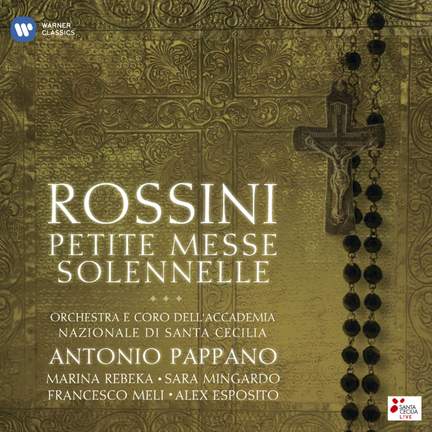
Rossini: Petite Messe solennelle
Marina Rebeka (soprano), Sara Mingardo (contralto), Francesco Meli (tenor), Alex Esposito (bass)
Orchestra e Coro dell’Accademia Nazionale di Santa Cecilia, Sir Antonio Pappano
Awards:
-
Presto Recording of the Week, 22nd April 2013

Pappano opts for a strong-limbed, purposeful approach that has the music sounding neither trite nor portentous, pleasingly bringing together its charm and expansiveness...The four high-quality...
Rossini: Petite Messe solennelle
Marina Rebeka (soprano), Sara Mingardo (contralto), Francesco Meli (tenor), Alex Esposito (bass)
Orchestra e Coro dell’Accademia Nazionale di Santa Cecilia, Sir Antonio Pappano
Purchase product
Awards:
-
Presto Recording of the Week, 22nd April 2013
Pappano opts for a strong-limbed, purposeful approach that has the music sounding neither trite nor portentous, pleasingly bringing together its charm and expansiveness...The four high-quality...
About
Following the success of two recent Rossini recordings, the sacred Stabat Mater and the opera William Tell, Antonio Pappano and his Orchestra e Coro dell’Accademia Nazionale di Santa Cecilia have taken on the composer’s late masterpiece, the Petite Messe solennelle. The soloists are Marina Rebeka, Sara Mingardo, Francesco Meli and Alex Esposito. Like the earlier-mentioned Rossini titles, the Petite Messe solennelle was recorded in the Orchestra’s acoustically fine home, the Auditorium Parco della Musica in Rome.
Gramophone hailed the recording of the Stabat Mater as “one of the great choral recordings” and “a revelatory account” in which “Tender and expressive word-painting … is a feature of the entire performance, underpinned by Pappano’s superbly crisp yet endlessly considerate pointing of Rossini’s trademark rhythmic invention.” The Sunday Times wrote, “Pappano lives the text like the great opera conductor he is, bringing consolation as well as fire and brimstone to Rossini’s heady spiritual brew.” Of their William Tell release, The Independent wrote, “Rossini's final opera is infrequently staged, and it's unlikely anyone will try again soon: why risk comparison with Pappano's magisterial presentation, the latest in a string of triumphs for the maestro?”
Gioachino Rossini composed the Petite Messe solennelle in 1863 at his villa in Passy on the outskirts of Paris. He had moved there from Italy in 1855 with his Parisian-born second wife Olympe Pelissier and found that, after years of ill health during which he had stopped composing altogether, he felt much better in Paris. When he began to compose again, rather than operas, he turned his hand to smaller-scale works, instrumentally accompanied songs, piano and chamber music, which he referred to as his ‘Péchées de vieillesse’ (‘Sins of old age’). Many were performed at the Saturday evening soirees that he and his wife hosted at their home starting in the winter of 1858.
The Count and Countess Pillet-Will were bankers and friends of Rossini and it was to Countess Louise that the Petite Messe solennelle is dedicated. It is scored for twelve voices (four soloists and eight additional choristers), two pianos and harmonium. Rossini wrote at the top of the score, “Twelve singers of the three sexes, men, women and castrati will suffice for its performance: that is, eight for the chorus, four for the solos, twelve cherubim all told.” At the end of the score, he wrote, “Dear Lord, here it is finished, this poor little mass. Have I just written sacred music, or rather sacrilegious music? I was born for opera buffa, as you well know. Not much technique, a little bit of heart, that is all. Blessings to you and grant me Paradise.” The work was performed to consecrate the newly built private chapel at the Count and Countess’s grand new home and, shortly thereafter, for invited guests, although the composer did not attend either performance.
After that, he undertook to orchestrate the work – to ensure that no one else would do it after his death. During the orchestration process in 1867, he decided to add a previously composed piece for soprano, O salutaris hostia, between the Sanctus and the Agnus Dei of the Mass. On completion of the orchestration, Rossini put both versions away, permitting no further performances of either during his lifetime.
Shortly after Rossini’s death in November 1868, however, his widow sold performance rights to the orchestrated version to the impresario Maurice Strakosch, who arranged the first performance at the Théâtre Italien in Paris on 28th February 1869, as close as possible to the composer’s leap-year birthday on 29 February.
The soloists on this recording are the young Latvian soprano Marina Rebeka, whose recent debuts at Covent Garden, the Deutsche Oper Berlin, Wiener Staatsoper, Salzburg Festival and Metropolitan Opera have been superlatively received; the award-winning Italian contralto Sara Mingardo, whose voice has been praised for its “extraordinarily rich contralto depths and interpretive capabilities”; the Italian tenor Francesco Meli, who made his Covent Garden and MET debuts in Rigoletto, performed at La Scala and in Vienna with Riccardo Muti and recorded La sonnambula with Natalie Dessay and Sara Mingardo for Virgin Classics; and the young Italian bass Alex Esposito, especially noted for his interpretations of works by Mozart and Rossini.
Contents and tracklist
- Orchestra dell'Accademia Nazionale di Santa Cecilia, Coro dell'Accademia Nazionale Di Santa Cecilia
- Antonio Pappano
- Recorded: 2012-11-01
- Recording Venue: Sala Santa Cecilia, Auditorium Parco della Musica, Rome
Spotlight on this release
-
An error occurred.
Try watching this video on www.youtube.com, or enable JavaScript if it is disabled in your browser.
-
Ludovic Tézier, Marina Rebeka and Francesco Meli on Simon Boccanegra
25th Feb 2026
The stars of a new account of Verdi's political thriller on Prima Classic discuss their roles, some of the singers and conductors who have inspired them in this music – and why there are ‘ghosts everywhere’ in the theatre where they recorded...
-
Pappano conducts Rossini’s Petite messe solennelle
22nd Apr 2013
So theatrical that you can practically smell the greasepaint, Rossini’s ‘old man’s folly’ receives luxury treatment from the conductor and his Roman orchestra, with Marina Rebeka, Sara Mingardo, Francesco Meli and Alex Esposito making up a full-blooded operatic solo quartet.


Awards and reviews
-
Presto Recording of the Week22nd April 2013
 June 2013
Pappano opts for a strong-limbed, purposeful approach that has the music sounding neither trite nor portentous, pleasingly bringing together its charm and expansiveness...The four high-quality soloists tread the same fine line with likeable sureness, while blending nicely together.
 13th April 2013
Pappano and his Santa Cecilia forces bring invigorating ardour to the composer’s treatment of the Latin Mass
 June 2013
The soloists have been well chosen. Senior among them is Sara Mingardo...Her fruity, not hooty, tones are clearly heard in the finely balanced ensembles: nobody is drowned by anyone else...The soprano of Rebeka has a gleam and a pureness but also some body, and she is capable of inflecting her music with gentle shading.
 22nd April 2013
One of the hallmarks of Pappano’s previous recordings with these forces has been his happy knack of assembling solo quartets of apparently very disparate voices which somehow come together quite magically, and this musical alchemy is in evidence again here: he really has the balancing of light and dark timbres down to a fine art.
 21st April 2013
Pappano’s grand-operatic account in full orchestral clothing has a fine quartet of opera singers...but its glory is the wonderful Santa Cecilia chorus.
 3rd May 2013
The acoustics are bright and well-defined. The microphones, and doubtless Pappano as well, ensure that such details as the cellos’ insistent accompaniment to the “Kyrie” is given proper weight and that, for example, the harp comes through in “Qui tollis peccata mundi”.
 26th April 2013
Pappano’s choir, far more than 12, remains endlessly mellifluous and secure as the music proceeds over 80 minutes, offering consolation and delight...The soprano Marina Rebeka stands out...Conductor, choir and orchestra always give Rossini their heart and soul.