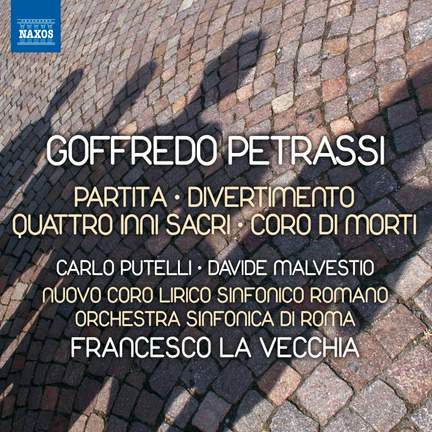
Petrassi: Partita & Divertimento
Carlo Putelli (tenor) & Davide Malvestio (bass)
Orchestra Sinfonica di Roma, Nuovo Coro Lirico Sinfonico Romano, Francesco La Vecchia
Putelli is a soloist of passionate dramatic conviction, ably communicating the variety in the composer's reactions to these texts...The Roman choir and orchestra certainly have the measure of...
Petrassi: Partita & Divertimento
Carlo Putelli (tenor) & Davide Malvestio (bass)
Orchestra Sinfonica di Roma, Nuovo Coro Lirico Sinfonico Romano, Francesco La Vecchia
Purchase product
Putelli is a soloist of passionate dramatic conviction, ably communicating the variety in the composer's reactions to these texts...The Roman choir and orchestra certainly have the measure of...
About
Goffredo Petrassi was one of the most important Italian composers of the twentieth century. Beginning with the previously unrecorded Divertimento in C, this release focuses on Petrassi’s compositions of the 1930s and 40s. Employing an unusual mix of styles and idioms, as well as brief quotations from Ravel and Stravinsky, the Partita was the first work to win him renown. The eloquent Quattro inni sacri (Four Sacred Hymns), described by the composer as ‘music of today for the faithful of today’, were intended as an antidote ‘to the unctuous and conformist style in use in our churches’ but, in reality, are only ever heard in the concert hall. Soon after the start of the Second World War, Petrassi wrote his meditative madrigale drammatico, Coro di Morti (Chorus of the Dead), the composer’s first setting of a non-sacred text and perhaps his finest achievement in the field of vocal music.
Contents and tracklist
- Rome Symphony Orchestra
- Francesco La Vecchia
- Rome Symphony Orchestra
- Francesco La Vecchia
- Carlo Putelli, Davide Malvestio
- Rome Symphony Orchestra
- Francesco La Vecchia
- Coro Lirico Sinfonico Romano, Rome Symphony Orchestra
- Francesco La Vecchia
Awards and reviews
 July/August 2013
Putelli is a soloist of passionate dramatic conviction, ably communicating the variety in the composer's reactions to these texts...The Roman choir and orchestra certainly have the measure of the work under Francesco La Vecchia's assured direction.