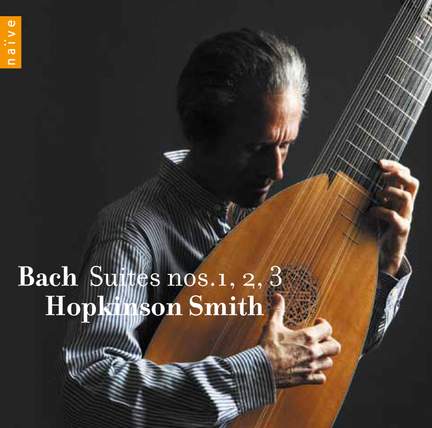
Special offer. JS Bach: Suites Nos. 1-3
Transcriptions by Hopkinson Smith
Hopkinson Smith (German theorbo Joël van Lennep, Rindge, New Hampshire, 1986)
for anyone knowing these suites well, this version will prove totally riveting - I haven't listened more intently for a long time...apart from a curiously limited dynamic range, Smith's playing...
Special offer. JS Bach: Suites Nos. 1-3
Transcriptions by Hopkinson Smith
Hopkinson Smith (German theorbo Joël van Lennep, Rindge, New Hampshire, 1986)
Purchase product
for anyone knowing these suites well, this version will prove totally riveting - I haven't listened more intently for a long time...apart from a curiously limited dynamic range, Smith's playing...
About
One of today’s 'popes' of early and baroque lute playing, Hopkinson Smith returns to the magic masterpieces of Bach and records the renowned Suites BWV 1007, 1008 and 1009, transcribed by himself for the German theorbo...
Bach was a musical ecologist, the masterful recycler of his own compositions, arranging more than a few from one instrument or combination of instruments to another. Many of his works seem conceived on a somewhat abstract plane, above and beyond any specific instrument, and it was completely natural for the pragmatic 18th-century mind and ear to adapt them to the instrument of its choice.
Among the so-called ‘official’ lute works of Bach, there exist two such adaptations: from the solo violin repertoire, the Third Partita, BWV 1006, becomes BWV 1006a for the lute, and the Fifth Cello Suite is transformed into the Lute Suite in G minor, BWV 995. Of course, lutenists had been adapting music for their instrument for centuries. More than half of the continental lute music of the Renaissance is made up of adaptations of vocal works. In the French baroque, Robert de Visée couldn’t stop making transcriptions for his theorbo of orchestral and keyboard works by his contemporaries. The great 18th-century German lutenist, Sylvius Weiss, a friend of Bach’s, was said to have played violin concertos directly on the lute. These examples of adaptations are not given as a kind of ‘justification’ for the present project as if the idea needed to be defended historically. It is more to guide the modern musical thinker (who sometimes knows more about ‘authenticity’ than did the musicians of former times) to the state of experimentation and discovery that is completely natural for the musician: one sits alone with one’s instrument without a score, playing melodies and harmonies that one has heard here or there and making them one’s own.
Contents and tracklist
- Hopkinson Smith (theorbo)
- Recorded: October 2012
- Recording Venue: the MC2, Grenoble, France
- Hopkinson Smith (theorbo)
- Recorded: October 2012
- Recording Venue: the MC2, Grenoble, France
- Hopkinson Smith (theorbo)
- Recorded: October 2012
- Recording Venue: the MC2, Grenoble, France
Awards and reviews
 September 2013
for anyone knowing these suites well, this version will prove totally riveting - I haven't listened more intently for a long time...apart from a curiously limited dynamic range, Smith's playing is profoundly sensitive.
 2nd July 2013
Smith has great dignity and poise. Dignity is an especially good word for his noble but restrained way with the emotion of the Second Suite