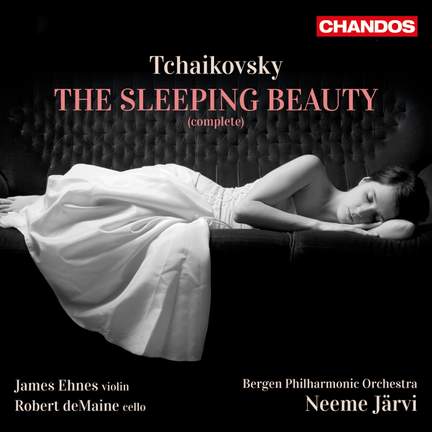
Special offer. Tchaikovsky: Sleeping Beauty, Op. 66
James Ehnes (violin), Robert deMaine (cello)
Bergen Philharmonic Orchestra, Neeme Järvi
Awards:
-
Presto Recording of the Week, 10th December 2012

The Bergen Philharmonic proves an ideal instrument for one of Tchaikovsky's most magical scores. Neeme Jarvi's every demand is met with immaculate playing, recorded in a warm but not too resonant...
Special offer. Tchaikovsky: Sleeping Beauty, Op. 66
James Ehnes (violin), Robert deMaine (cello)
Bergen Philharmonic Orchestra, Neeme Järvi
Purchase product
Awards:
-
Presto Recording of the Week, 10th December 2012
The Bergen Philharmonic proves an ideal instrument for one of Tchaikovsky's most magical scores. Neeme Jarvi's every demand is met with immaculate playing, recorded in a warm but not too resonant...
About
This two-disc set marks the beginning of a new project devoted to Tchaikovsky’s ballet scores. We start the survey with the complete score of The Sleeping Beauty, recorded on SACD. Swan Lake and The Nutcracker will follow in 2013 and 2014, respectively.
Tchaikovsky was approached by the Director of the Imperial Theatres in St Petersburg, Ivan Vsevolozhsky, in 1888 about a possible ballet adaptation of Charles Perrault’s La Belle au bois dormant (The Sleeping Beauty). The vision was to stage the production in the style of Louis XIV, allowing the musical fantasy to run high and melodies to be written in the spirit of Lully, Bach, and Rameau. This proposal for a fairy-tale ballet rooted firmly in both the rococo and baroque periods appealed to Tchaikovsky, and The Sleeping Beauty was premiered in 1890, with choreography by Petipa, the principal choreographer of his day.
Elaborately constructed, the ballet places its focus undeniably on the two main conflicting forces of good (the Lilac Fairy) and evil (Carabosse). Each has a representative leitmotif, which runs through the entire ballet, serving as an important thread to the underlying plot. Tchaikovsky’s use of what, at the time, were considered new and unorthodox instrumental combinations went on to inspire a new generation of composers, among them Stravinsky, who declared The Sleeping Beauty to be Tchaikovsky’s chef d’œuvre.
The Sleeping Beauty is here performed by the Bergen Philharmonic Orchestra under Neeme Järvi, who is celebrating two major milestones this year: a thirty-year recording career with Chandos Records, and his own seventy-fifth birthday. Orchestra and conductor are joined by the pre-eminent violinist James Ehnes, one of the most dynamic and exciting performers in classical music today.
Contents and tracklist
- James Ehnes (violin), Robert deMaine (cello)
- Bergen Filharmoniske Orkester
- Neeme Järvi
- Recorded: 18-23 June 2012
- Recording Venue: Grieghallen, Bergen, Norway
Spotlight on this release
-
Tchaikovsky's Sleeping Beauty from Neeme Järvi
10th Dec 2012
A new trilogy of complete Tchaikovsky ballet scores from the veteran Estonian conductor and the Bergen Philharmonic gets off to a glittering start, with outstanding solo contributions from violinist James Ehnes and cellist Robert deMaine.

Awards and reviews
-
Presto Recording of the Week10th December 2012
 February 2013
The Bergen Philharmonic proves an ideal instrument for one of Tchaikovsky's most magical scores. Neeme Jarvi's every demand is met with immaculate playing, recorded in a warm but not too resonant acoustic...That said, Jarvi chooses some quirky tempos...there is plenty here to delight lovers of this ballet.
 5th January 2013
[Järvi] turns a second-tier orchestra into a world beater, holding the Bergen Philharmonic in the palm of his hand. Despite speeds that are noticeably faster than you would expect in the theatre, Järvi makes every phrase dance and smile.
 January 2013
This is a good, practical interpretation of The Sleeping Beauty. The playing by the Bergen Philharmonic is strong and spirited: Jarvi's conducting is rational, adopting as it does the natural pacings and colouristic inflections from which it is possible to appreciate the character of the dances in one's mind's eye...in general Järvi does a sound job in sustaining the dramatic flow.
 December 2012
Järvi seems never to put a foot wrong and the Bergen orchestra impresses as much, conducted by him, as it does under its principal conductor Andrew Litton... the producers have pulled out all the stops and engaged no less a violinist than James Ehnes to play the important violin solos, a strikingly indulgent decision which pays dividends because Ehnes' outstanding technique makes these sections truly memorable.
 10th December 2012
Järvi's tempos generally verge on the fast side...and while I’m not convinced that every bar could be danced to at these speeds, this is after all a recording rather than a backing track for a ballet performance, and it unquestionably works in delivering thrilling climaxes and genuine excitement. The orchestral playing is ravishing, and the sound – ranging from shimmering cymbals to rasping brass – is superbly captured by Ralph Couzens and his team.
 23rd December 2012
From the outset...it is clear that Jarvi has no intention of lingering. His brisk allegros would probably rush the most virtuosic ballerinas off their feet in the theatre. On record, without the distraction of spectacle and dancing, the dramatic momentum hardly lets up, although he and the excellent Bergen players luxuriate in the rapt steps of Aurora’s famous Rose Adagio.
 10th January 2013
You might find yourselves in two minds about it. Järvi's extreme speeds result in a performance to which you can't imagine anyone dancing...The playing is ravishing, though, and a couple of glamorous guest instrumentalists, James Ehnes and Robert deMaine, add real lustre to the concertante violin and cello solos respectively.