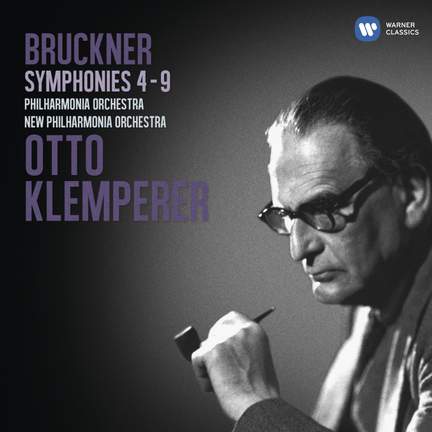
Bruckner: Symphonies Nos. 4 - 9
Philharmonia Orchestra, New Philharmonia Orchestra, Otto Klemperer
These performances from 1963 to 1970 are captured in excellent sound, and though nearly fifty years has passed since the first of them – the Fourth – there is no need to be in the least apologetic...
Bruckner: Symphonies Nos. 4 - 9
Philharmonia Orchestra, New Philharmonia Orchestra, Otto Klemperer
Purchase product
These performances from 1963 to 1970 are captured in excellent sound, and though nearly fifty years has passed since the first of them – the Fourth – there is no need to be in the least apologetic...
About
Otto Klemperer was born on 14th May 1885 in Breslau, Silesia (now Wroclaw, Poland) and died on 6th July 1973 in Zurich and hence next year we mark 40 years since his passing. Although disfigured by a stroke suffered whilst a brain tumour was being removed he became a world-renowned conductor whose recordings became and remain touchstones for the EMI catalogue.
Having completed the highly successful series of Beethoven recordings it was natural for EMI to seek further Romantic symphonies from Otto Klemperer. Although those by Anton Bruckner had been altered by good-meaning editors to make them more attractive to audiences of the time there were now editions which had attempted to revert to Bruckner’s original intentions and the advent of the LP with their much longer sides made recordings of these works much easier.
The first two to be recorded were Nos. 7 and 4 in November 1960 and September 1963 respectively. By the time of the next recording – of No. 6 in November 1964 – Walter Legge had left EMI and the orchestra had, with a great deal of support from Klemperer, established itself as a separate body and now called itself the New Philharmonia Orchestra. The recording of No. 5 followed in March 1967 with Nos. 9 and 8 following in February and October/November 1970.
Contents and tracklist
Awards and reviews
 16th May 2013
These performances from 1963 to 1970 are captured in excellent sound, and though nearly fifty years has passed since the first of them – the Fourth – there is no need to be in the least apologetic about the sound quality...Even the collector who already possesses this repertoire in alternative performances will find this set rewarding and stimulating.
 6th December 2012
like the conductor himself, craggy and uncompromising...What gives them such strength and purpose is their faultless sense of symphonic architecture. The reputation for slow tempi that stuck with Klemperer in the last decades has never seemed more irrelevant