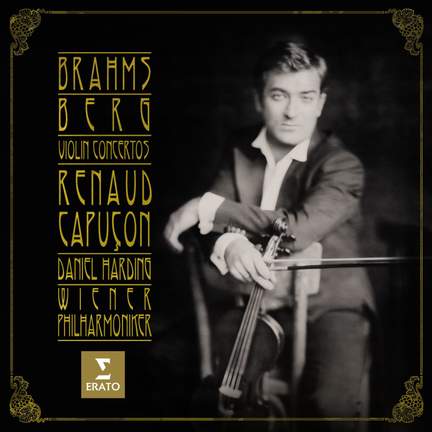
Special offer. Brahms & Berg: Violin Concertos
Renaud Capucon (violin)
Wiener Philharmoniker, Daniel Harding
Despite the intensely lyrical nature of the violinist's tone, Capucon also projects a harsher more angst-ridden view of [Berg's] music...the Brahms is something of a mixed bag. Things don't...
Special offer. Brahms & Berg: Violin Concertos
Renaud Capucon (violin)
Wiener Philharmoniker, Daniel Harding
Purchase product
Despite the intensely lyrical nature of the violinist's tone, Capucon also projects a harsher more angst-ridden view of [Berg's] music...the Brahms is something of a mixed bag. Things don't...
About
I’ve long dreamed of playing with the Wiener Philharmoniker,” said violinist Renaud Capuçon in 2011, and his dream has come true with this recording of two concerto masterpieces of the Austro-German repertoire: the Brahms and the Berg, composed almost 50 years apart. The conductor is Daniel Harding, who has built a close relationship the legendary Viennese orchestra.
Renaud Capuçon, the leading French violinist of his generation, joins the British conductor Daniel Harding and the august Wiener Philharmoniker for two landmark concertos of the Austro-German repertoire. The expansive Brahms concerto, first performed in 1878 by Joseph Joachim, is a peak of the composer’s glowingly warm Romanticism, while the Berg concerto – written in 1935, the last year of Berg’s life, and dedicated to the memory of Manon Gropius, who had died aged just 19 – poignantly blends the atonality of the Second Viennese School with subtle lyricism and, in its second movement, a haunting Bach chorale.
The contrast between the two works echoes the programme of Capuçon’s 2009 Virgin Classics release of the Beethoven and Korngold concertos, described by BBC Music as “a beautiful and appropriate pairing” and “perfect choices for Capuçon’s elegantly understated delivery”. In 2011, after a US performance of the Korngold –composed 10 years after the Berg and a more extrovert offshoot of the Austro-German tradition – the Chicago Tribune praised Capuçon’s “panache, sensitivity and sizzling virtuosity” and “the rich, penetrating sound he drew from his instrument, a 1737 Guarneri del Gesù once belonging to Isaac Stern”.
“I’ve long dreamed of playing with the Wiener Philharmoniker, which is of course one of the world’s most extraordinary orchestras,” said Capuçon in an interview in October 2011. “I’m going to record with them in December, so that will be a dream come true!” This release is the fruit of those recording sessions. Harding made his debut with the legendary Viennese orchestra in 2004, when he was not yet 30, and has since built up a close relationship with its players. Describing the conductor’s approach to Brahms, The Guardian has written that: “Harding is immaculate in his ability to negotiate the complex relationship between feeling and form.”
Capuçon, meanwhile, has pronounced Brahms one of his favourite composers, “for his serenity and the sense of resurrection that he conveys”. His Virgin Classics recording of Brahms chamber works, with his cellist brother Gautier and the pianist Nicholas Angelich was described by Gramophone as “sure to kindle anyone's enthusiasm for Brahms. Warm, beautifully balanced tone stresses the composer's romantic side, as does the expansive phrasing. There's a feeling of spontaneity, too, as though each player is discovering new aspects to the music while recording it.”
Contents and tracklist
Awards and reviews
 November 2012
Despite the intensely lyrical nature of the violinist's tone, Capucon also projects a harsher more angst-ridden view of [Berg's] music...the Brahms is something of a mixed bag. Things don't get off to a good start with a poorly focused orchestral tutti...The performance is certainly lifted by Capucon's gloriously rich sound which seems to galvanise the orchestra into playing the score with a greater degree of involvement.
 November 2012
The instruments of the Vienna Philharmonic blend with particular smoothness and the bass-line is wonderfully firm and resonant. Capucon plays with passionate commitment; he's particualrly successful in the first movements of the Brahms in keeping a sense of momentum within a flexible tempo...Capucon's Berg has a similar character to his Brahms - full of passionate feeling but set in a context of blended, generally suave sonorities.
 January 2013
Capuçon’s playing is a delight throughout. At the soloist’s entry in the Brahms concerto, he strides onto centre-stage with defiance but quickly allows the orchestra to tame his stridency so that within seconds the violin’s tone is purring and beautiful...The Berg concerto is just as well played...He is in love with this work...and his affection for it comes through with every lovingly crafted phrase.
 20th September 2012
a gorgeously expansive account of the Brahms, allowing the long-limbed melodies in the first two movements all the space they need...Just occasionally it all becomes a bit too indulgent...The Berg, too, is wonderfully fluent, but quite detached.
 21st September 2012
Capuçon has an impressive grasp of the concerto’s expressive contours, using his technical arsenal with finesse and tracing the music’s breadth of line and its arching shapes while maintaining its inner momentum. The rhythmic punch and energy of the finale are echoed by the orchestra’s powerful attack and buoyancy...This is altogether a remarkable disc.