Special offer. Schubert: Symphonies Nos. 1-9
Les Musiciens du Louvre (on period instruments), Marc Minkowski
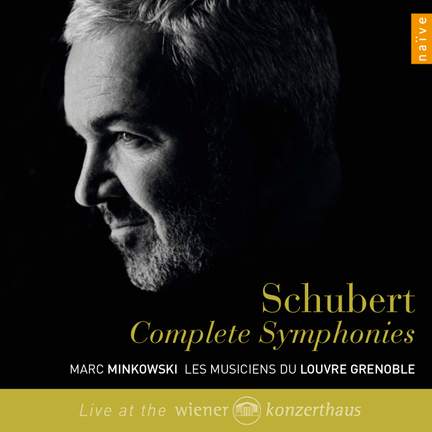
Minkowski takes a surprisingly conventional view of these pieces, though his performances, recorded 'live' in Vienna's Konzerthaus, are none the worse for that...impressive performances, greatly...
Special offer. Schubert: Symphonies Nos. 1-9
Les Musiciens du Louvre (on period instruments), Marc Minkowski
Purchase product
Minkowski takes a surprisingly conventional view of these pieces, though his performances, recorded 'live' in Vienna's Konzerthaus, are none the worse for that...impressive performances, greatly...
About
Following the extremely successful recording of Haydn complete London Symphonies released in 2010, Marc Minkowski, Naïve and the Wiener Konzerthaus set up a new project, even more ambitious although similar in form: to perform for the Viennese audience and record the complete symphonies of Schubert in the same week, in March this year. 2012 marks the 30th anniversary of Les Musiciens du Louvre Grenoble. Major concerts will take place in Paris this Autumn to celebrate this event.
This 4-CD set on period instruments sheds a new light on all the Symphonies, some not as highly considered as perhaps they should be.
Les Musiciens du Louvre Grenoble use instruments of the Classical era, laid out according to Viennese tradition, with the violins on either side of the conductor and the double basses in a line facing him. The oboe too is of Viennese manufacture: its highly idiosyncratic bore produces a sound, at once nasal and tender, that is immediately recognisable – indeed, despite developments in instrument making and the multiplication of keys, the modern version of this instrument is still not so very far removed from the oboe that Schubert knew. Four double basses are used in general but only two for the Fifth Symphony, which is written in a more central tessitura and dispenses with clarinets, trumpets, and timpani.
‘In the “Great C major”, on the other hand,’ explains Marc Minkowski, ‘Schubert’s ambitions recall, relatively speaking, those of Haydn in The Creation or Beethoven in the Ninth Symphony. That’s why I chose to deploy five basses and to double the first flute and oboe parts and the second clarinet and bassoon parts: the use of three instruments per section allows us to obtain that organ sonority that was later to define the Bruckner rchestra, whereas the woodwind, in the early symphonies, sound like a pastoral group. When all is said and done, the key word for all this music is melancholy, even at the height of virtuosity – and goodness knows that these works, more ideal than practical, remain behind their apparent simplicity very risky to bring off in performance. Schubert wrote with genius for the orchestra, but his thought, much more than that of Mozart or Beethoven, was situated outside reality, in the tumultuous imagination of a young – sometimes very young – man, at the frontiers of the possible.’
Contents and tracklist
- Musiciens du Louvre, Les
- Marc Minkowski
- Musiciens du Louvre, Les
- Marc Minkowski
- Musiciens du Louvre, Les
- Marc Minkowski
- Musiciens du Louvre, Les
- Marc Minkowski
- Musiciens du Louvre, Les
- Marc Minkowski
- Musiciens du Louvre, Les
- Marc Minkowski
- Musiciens du Louvre, Les
- Marc Minkowski
- Musiciens du Louvre, Les
- Marc Minkowski
Spotlight on this release
-
An error occurred.
Try watching this video on www.youtube.com, or enable JavaScript if it is disabled in your browser.
Awards and reviews
 March 2013
Minkowski takes a surprisingly conventional view of these pieces, though his performances, recorded 'live' in Vienna's Konzerthaus, are none the worse for that...impressive performances, greatly aided by the skilful playing of Les Musiciens du Louvre Grenoble and their admirable first oboe...This set can take its place among the very best of Schubert Symphony cycles.
Early Music Review December 2012
One need hear only the beautifully balanced and weighted wind chords at the opening of the Symphony No. 3 to be aware that this set is going to have exceptional qualities. And so it proves … a performance that is utterly compelling from first to last note … an exceptional set
 18th November 2012
these pieces gain most from the transparent textures, woody woodwinds and natural, alfresco-sounding brass.
 20th December 2012
the performances of the earlier works are lithe, energised and generally transparent – the Mozartian freshness of the Fifth is beautifully judged, for instance. The treatment of the final two symphonies is less convincing, however.
 2nd February 2013
[Minkowski] never treats the first six as a series of dry warm-up exercises...Period timbres lend the former a huskier, more subdued tone, the narrow-bore trombones adding plenty of colour...this C Major doesn’t feel like too much of a good thing, despite Schubert’s exhaustive repeats. Minkowski’s unforced geniality in the Scherzo’s trio is a joy. Amazing stuff, and beautifully recorded in a glowing acoustic.