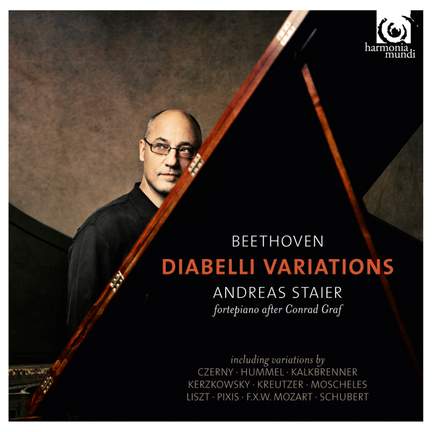
Beethoven: Diabelli Variations
Andreas Staier (fortepiano after Conrad Graf)
Awards:
-
BBC Music Magazine Awards, 2013, Instrumental Finalist

-
BBC Music Magazine, August 2012, Disc of the month

-
Gramophone Magazine, August 2012, Editor's Choice

-
Building a Library, June 2017, First Choice

The endlessly ear-opening consequences are riveting; the wide-ranging aplomb of Beethoven's Variations could have been conceived with Staier's musical curiosity and flair in mind...This isn't...
Beethoven: Diabelli Variations
Andreas Staier (fortepiano after Conrad Graf)
Purchase product
Awards:
-
BBC Music Magazine Awards, 2013, Instrumental Finalist
-
BBC Music Magazine, August 2012, Disc of the month
-
Gramophone Magazine, August 2012, Editor's Choice
-
Building a Library, June 2017, First Choice
The endlessly ear-opening consequences are riveting; the wide-ranging aplomb of Beethoven's Variations could have been conceived with Staier's musical curiosity and flair in mind...This isn't...
About
As is his custom, Andreas Staier has gone back to the original manuscript of one of the most famous sets of variations in history: Beethoven’s 'Diabelli Variations'. He has not however, restricted his work to recording the magnum opus, since the CD begins with a selection of variations written by some of the other 50 composers Diabelli asked to take part in his project. Here you can discover the very first stirrings of Liszt’s virtuosity (aged 11), the music of Mozart’s son, the unexpected variations of Kreutzer and Kalkbrenner, and the 'Diabelli Variation' of a certain Franz Schubert. A thrilling musical investigation with Andreas Staier's own 'Introduction'.
"My intention with the Introduction was to create a sound-space that separates the twelve ‘preludes’, from Czerny to Schubert, from Beethoven’s great cycle. It’s a pause for breath in what is otherwise rigorously composed music. So I think the improvisatory element is perfectly appropriate here. And that way one can ensure that Diabelli’s waltz has the necessary freshness the second time it’s played. I keep to the essence of what can be made out from Beethoven’s sketch of 1819, and stay close to the theme. The striking three-note motif with the combination of the intervals of a semitone and a rising third suggests an echo of the finale from the Piano Sonata in D major op.10 no.3. But I didn’t develop the interval of the descending fourth in the sketch because it’s so clearly presented by Beethoven himself in the very first variation...
This fascinating manuscript allows us to infer Beethoven’s choleric and impatient sides, but not the ironic side to his character. The annotations show his worries and difficulties during a pretty laborious process of composition. What began as a fair copy increasingly turns into a working manuscript. With the dynamics of the handwriting and the many corrections and erasures, it provides a whole range of pointers to the composer’s intentions. It’s a treasure trove for the interpreter." Andreas Staier
Contents and tracklist
Awards and reviews
-
BBC Music MagazineAugust 2012Disc of the month
-
Gramophone MagazineAugust 2012Editor's Choice
 August 2012
The endlessly ear-opening consequences are riveting; the wide-ranging aplomb of Beethoven's Variations could have been conceived with Staier's musical curiosity and flair in mind...This isn't just an indisputably great performance on fortepiano; it's a great performance full stop. Given Staier's virtuosity and insight, what price Hammerklavier next?
 August 2012
Staier's perfectly judged tempi, angular demeanour, characterful contrasts, biting accents and cumulative sweep add up to a performance that abounds with probing details yet never loses sight of the music's grand design...This is far away the most stimulating and best-played fortepiano Diabelli Variations on compact disc.
 June 2012
His interpretative approach scarcely needs describing: relatively straightforward in delivery, technically impeccable, making light of the inherent unevenness of the instruments...An outstanding achievement...which certainly whets the appetite for more Beethoven to come.
 24th September 2012
the most infectiously joyous recording I have of the Diabellis. At times, Staier's performance makes me almost want to get up and dance … delicious, rich sound … Staier’s performance is lively, aggressive and full of joy. It is a delight to hear him play this work … this is a great recording of a great work, and one that any lover of Beethoven's piano works should get.
 27th May 2012
Staier finds unexpected colours in this most mercurial, witty and enigmatic of the late piano works. Anybody accustomed to the “plinky-plonk” sound of period instruments in modern...will be astonished at the spectrum of timbres Staier conjures from this fortepiano...A piano disc for the ages.
 16th May 2012
It's safe to predict that very few people who hear this extraordinary performance...will have heard one quite like it before...his performance is about much more than special effects. Staier's variations of touch and tone and the nuances of his pedalling would be remarkable on a modern concert grand, let alone such an early instrument, while he is always alert to the ways in which he can articulate and alter the pacing
 3rd May 2012
Every now and then a CD comes along which paints a familiar piece in completely new colours. This recording...is one. The pianist Andreas Staier achieves this partly by playing on a copy of an early19th-century fortepiano...But the really interesting colours are the one Staier makes himself...the CD is a triumph of musical intelligence and sensitivity, which, despite its learning, sounds completely free and natural.
The Independent on Sunday 29th April 2012
Staier's fortepiano is deliciously transparent, his musicianship revelatory.
Record Review 18th June 2017
He’s a pianist of endless imagination, who captures brilliantly both the darkness and the light of these extraordinary variations. Paradoxically, his period instrument makes this music sound even more startling, even more modern