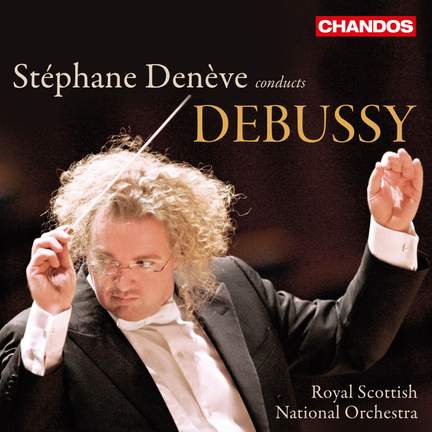
Special offer. Debussy: Orchestral Works
Royal Scottish National Orchestra, Stéphane Denève
Awards:
-
Gramophone Magazine, August 2012, Editor's Choice

Denève still summons a sensuous bloom in the Prélude, and thanks to his influence, the RSNO proves better than the French at their own game: these are among the most seductive Debussy performances...
Special offer. Debussy: Orchestral Works
Royal Scottish National Orchestra, Stéphane Denève
Purchase product
Awards:
-
Gramophone Magazine, August 2012, Editor's Choice
Denève still summons a sensuous bloom in the Prélude, and thanks to his influence, the RSNO proves better than the French at their own game: these are among the most seductive Debussy performances...
About
Recognised internationally as a conductor of the highest calibre, Stéphane Denève took up the post of Music Director of the Royal Scottish National Orchestra in 2005, and has since attracted attention from audiences and critics alike. This May, the conductor bids a fond farewell to Scotland and the RSNO with a series of ‘Au Revoir’ concerts, and of course, this disc of orchestral works by Debussy.
After the impact made by the production of Pelléas et Mélisande in 1902, the next orchestral work by Debussy was awaited with intense interest. La Mer did not disappoint, and is today widely considered to have been crucial in its influence on twentieth-century music. After completing this work, Debussy spent no fewer than seven years wrestling with what were to become Images for orchestra. Some critics were puzzled by the work and suggested that Debussy’s talent might have dried out. They were promptly put right in an article by Ravel, who accused them of ‘slowly closing their eyelids before the rising sun amid loud protestations that night is falling’.
With a sultry flute solo, Prélude à l’après-midi d’un faune opened an astonishing new world for western music. Debussy based this composition on a poem by Mallarmé, who wrote to the composer: ‘I have come from the concert, deeply moved: A miracle! that your illustration of L’Après-midi d’un faune should present no dissonance with my text, other than to venture further, truly, into nostalgia and light…’
The three Nocturnes feature some of Debussy’s most imaginative orchestral writing. In the words of the composer, ‘the title Nocturnes is… not meant to designate the usual form of a nocturne, but rather all the various impressions and the special effects of light that the word would suggest’. Debussy provided descriptions of the three movements. ‘Nuages’, for example, depicts ‘the slow, melancholy procession of the clouds, ending in a grey agony tinged with white’, and also the experience of standing ‘on the Pont de Solférino very late at night. Total silence. The Seine without a ripple, like a tarnished mirror’.
Contents and tracklist
Awards and reviews
-
Gramophone MagazineAugust 2012Editor's Choice
 9th June 2012
Denève still summons a sensuous bloom in the Prélude, and thanks to his influence, the RSNO proves better than the French at their own game: these are among the most seductive Debussy performances I have heard in years.
 August 2012
Denève shows how precise were [Debussy's] choices of instrumental colour and how well-defined and animated the images he was expressing through his music...There is nothing vague about these performances; rather they convey both the dynamism and the delicacy of the music with understanding and stimulating freshness.
 August 2012
his meticulous attention to detail is impressive, but what should be a complex, living seascape remains stubbornly one-dimensional...Outwardly brilliant, inwardly dull. Perplexing.
 3rd June 2012
his Debussy is his own, muscular yet transparent, colouristic yet atmospheric and mysterious...Even that symphonic warhorse La Mer sounds freshly reimagined by the young Frenchman, whose sense of the music’s ebb and flow, with surging climaxes, is unerring...an ideal way to acquire Debussy’s orchestral masterpieces
 22nd June 2012
Denève has clear ideas about the lucidity of Debussy’s scoring and he conducts the orchestra in a way that brings the poetic or visual pictures that inspired the music vividly and freshly to life...All are performed with finesse and with a combination of energy, discretion and colour that give them a luminous quality.