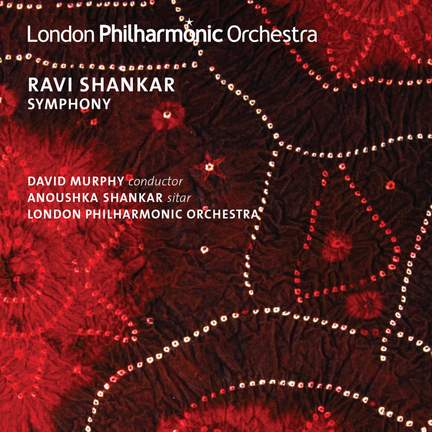
Shankar: Symphony
Anoushka Shankar (sitar)
London Philharmonic Orchestra, David Murphy
It's a tremendously attractive, sometimes serene, often joyous work, drawing on Indian melodic and rhythmic elements, European structures and developmental procedures, and textures from both...
Shankar: Symphony
Anoushka Shankar (sitar)
London Philharmonic Orchestra, David Murphy
Purchase product
It's a tremendously attractive, sometimes serene, often joyous work, drawing on Indian melodic and rhythmic elements, European structures and developmental procedures, and textures from both...
About
Legendary composer and sitarist Ravi Shankar is one of India’s most highly esteemed musical ambassadors, renowned for his pioneering work in bringing Indian music to the West. 2010 saw the première of his ambitious fusion work, his first symphony conceived for a Western symphony orchestra, which translates the aural sensibilities and sound-worlds of Indian music into a Western structural framework. In this live recording of the work’s première, David Murphy conducts the London Philharmonic Orchestra with Ravi Shankar’s daughter Anoushka on sitar.
Ravi Shankar travelled a great deal in the West as a child dancer in his elder brother Uday Shankar’s troupe of Indian musicians and dancers. During a long sojourn in Paris in the early 1930s he met many of the legends of Western classical music: George Enescu, the great Romanian violinist and composer who was then teaching the teenage Menuhin in Paris. Toscanini, Heifetz, Paderewski, Casals, Kreisler and the great Russian bass Chaliapin were some of the musical legends who made an impact on the young Ravi Shankar.
He also experienced the reaction of Westerners to hearing Indian music for the first time. He noticed that the Western ear is attuned to harmony, modulation and counterpoint: musical textures which of necessity are almost entirely absent in Indian music in order to maintain the melodic purity of the raga. He realised Western-trained ears needed an awareness of the rhythmic and melodic structures underpinning Indian music in order to appreciate it.
Thus in later years, Ravi Shankar became the first Indian musician to explain these concepts to his audiences. Through Ravi Shankar, Indian music began to have an influence on most genres of Western music: Yehudi Menuhin became a duo partner and George Harrison was another Western musician for whom the music of India resonated deeply. Harrison became a devoted student and lifelong friend, thus the influence of Indian music reached out to a whole generation.
Contents and tracklist
- David Murphy, London Philharmonic Orchestra, Anoushka Shankar
Awards and reviews
 September 2012
It's a tremendously attractive, sometimes serene, often joyous work, drawing on Indian melodic and rhythmic elements, European structures and developmental procedures, and textures from both traditions...[Anoushka] performs with her accustomed charm, aplomb and panache. Credit should also go to the flautists, who are given important work to do.
 28th April 2012
it's a resounding triumph, from the vibrant, animated opening movement “Kafi Zila” through an elegant, involving lento section of duetting flute and sitar, and an intriguing Indian scherzo whose hypnotic layerings of marimba, flute and sitar evoke echoes of American minimalism, through to the stirring, virtuoso finale.
 23rd June 2012
David Murphy, who helped Shankar with the work’s scoring and notation, conducts with energy. The recorded sound is clear and detailed.