Special offer. Beethoven: Symphonies Nos. 7 & 8
Wiener Philharmoniker, Claudio Abbado
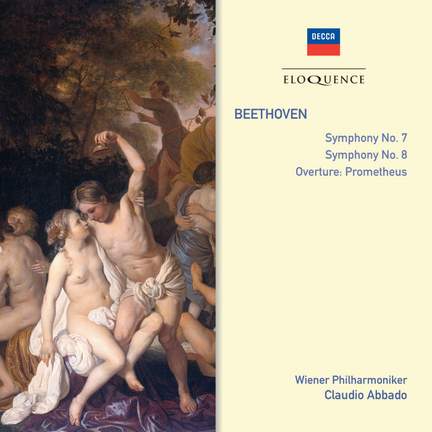
These very early Abbado recordings are far finer than his recent work on the composer, and may be as good a coupling of these two masterpieces as you can find.
Special offer. Beethoven: Symphonies Nos. 7 & 8
Wiener Philharmoniker, Claudio Abbado
Purchase product
These very early Abbado recordings are far finer than his recent work on the composer, and may be as good a coupling of these two masterpieces as you can find.
About
In the 1960s and 70s Claudio Abbado made several recordings for Decca – orchestral works by Mendelssohn, Beethoven and Bruckner, as well as 20th-century repertoire by Hindemith, Janácek and Prokofiev. This recording is part of that legacy and there are plenty of magical touches – real swagger in the finale of the Seventh Symphony, dashing humour in the finale of the Eighth, real nobility at the opening of the Creatures of Prometheus Overture. These were the only Beethoven recordings Abbado made for Decca and they are now collected on one CD. The Seventh and the Overture receive their first international release on CD.
Contents and tracklist
- Wiener Philharmoniker
- Claudio Abbado
- Recorded: 1966-04-29
- Recording Venue: Sofiensaal, Vienna
- Wiener Philharmoniker
- Claudio Abbado
- Recorded: 1968-11-17
- Recording Venue: Sofiensaal, Vienna
- Wiener Philharmoniker
- Claudio Abbado
- Recorded: 1966-05-03
- Recording Venue: Sofiensaal, Vienna
Awards and reviews
 November 2012
These very early Abbado recordings are far finer than his recent work on the composer, and may be as good a coupling of these two masterpieces as you can find.

Abbado's fresh and alert performance of the Beethoven is very attractive in drawing attention to the music rather than to the interpreter. The tempi are all well chosen, the rhythms well sprung, such key moments as the gentle conclusion of the first movement neatly pointed