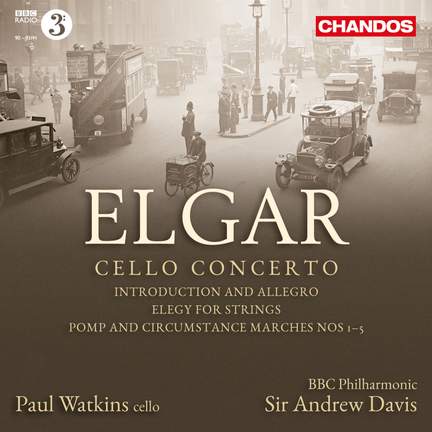
Elgar: Cello Concerto
Paul Watkins (cello)
BBC Philharmonic, Sir Andrew Davis
Awards:
-
Gramophone Magazine, July 2012, Editor's Choice

there are times when a recording of a popular classic comes along that's so fresh, understanding and heartfelt that it demands to be approached solely on its own terms. Paul Watkins's Elgar...
Elgar: Cello Concerto
Paul Watkins (cello)
BBC Philharmonic, Sir Andrew Davis
Purchase product
Awards:
-
Gramophone Magazine, July 2012, Editor's Choice
there are times when a recording of a popular classic comes along that's so fresh, understanding and heartfelt that it demands to be approached solely on its own terms. Paul Watkins's Elgar...
About
Paul Watkins is the cello soloist in a recording that showcases some of Elgar’s most popular works. He is accompanied by the BBC Philharmonic and Sir Andrew Davis, a conductor steeped in the English music tradition.
Elgar studied the violin from a young age, and had some early hopes of making a career as a soloist. Consequently, he wrote for the strings of the orchestra with a special understanding and flair, not least in a handful of works for strings alone. The showpiece among these is the Introduction and Allegro, written in 1904, for the newly formed London Symphony Orchestra to be included in an all-Elgar concert. The premiere performance was conducted by the composer.
Elgar started writing his Pomp and Circumstance Marches in 1901 in the wake of his national successes with the Enigma Variations and The Dream of Gerontius. The Marches vary considerably in mood. The First March gained worldwide fame largely due to the trio melody, which Elgar considered ‘a tune that comes once in a lifetime’, and the Second displays a certain air of urgency with its brazen horn calls and jaunty trio. Also on this disc is Elgar’s intimate and restrained Elegy for Strings.
The Cello Concerto in E minor, written in 1918 – 19, was the last major work Elgar completed. Its mood is often described as ‘autumnal’, and highly reflective of the ageing composer’s own state of mind. At the time of writing it, Elgar was concerned about the failing health of his wife and about his own waning popularity; he was deeply disturbed, too, by the horrors of the First World War. Paul Watkins writes of his experience of recording this work: ‘It is a privilege to have the opportunity to add my voice to the many different interpretations of this iconic work. I prepared for this recording by using my experience as a conductor: in other words, to study Elgar’s masterful score as deeply as possible, and to realise how intimately the solo cello is linked to the orchestra throughout. In this respect I feel fortunate to have been working with Sir Andrew Davis. He is the most natural and intelligent interpreter of Elgar I know.’
Contents and tracklist
Awards and reviews
-
Gramophone MagazineJuly 2012Editor's Choice
 July 2012
there are times when a recording of a popular classic comes along that's so fresh, understanding and heartfelt that it demands to be approached solely on its own terms. Paul Watkins's Elgar Cello Concerto is firmly in that class. Watkins's emotional shading is individual, without it ever sounding as though he's trying to be individual.
 25th July 2012
Paul Watkins is a sensitive soloist, and he and Davis clearly have a special rapport...The BBC Philharmonic strings are richly full-blooded and rhythmically taught in the Introduction and Allegro. There is a wonderful ebb and flow to the lighter passages, which radiate warmth and geniality
 July 2012
Watkins plays with consummate artistry, his golden-toned and technically flawless contribution striking a judicious balance between classical poise and unexaggerated depth of feeling...Durable rewards guaranteed, then, and the same certainly holds true for Davis's dashingly articulate, meticulously observant and superbly musical handling [of the Marches]...for the two main offerings alone every Elgarian should investigate this release
 May 2012
Davis, an Elgarian of perception, understands the smallest implications in the light but beautiful orchestration, ideal accompaniment to the cello. Watkins is watchful of the detail in the heartfelt opening statement...Watkins and Davis give [the finale]...a distinct dryness of utterance. Much falls into place with this approach
 June 2012
Watkins does so much more than just play the tunes. His range of colour and expression is tremendous, and the instrument he uses he describes in the booklet as having a “combination of burnished woody timbres and a plangent expressivity, reminiscent perhaps of an English tenor voice.”..With stunning recorded sound, what more could one ask.
 22nd April 2012
Watkins writes in the booklet that he found it “daunting” to record Elgar’s Cello Concerto...but he rises superbly to the challenge. His playing — of exceptional beauty, refinement and technical address — is all the more remarkable given that he is no longer a full-time soloist.... With Davis, one of the most experienced of all Elgarians, as his conductor, this is a valedictory account of the composer’s last important orchestral work
 5th April 2012
Watkins' account seems the best to have appeared on disc for years. It has intensity, presence and warmth, which never topples over into sentimentality, and Davis and the BBC Philharmonic accompany with panache; the exchanges in the scherzo are wonderfully deft. The rest of disc is equally fine.
 6th April 2012
Poetic pianissimos, abrupt explosions, finely tapered phrases: each of Watkins’s expressive details immediately reach the listener...There’s also perfect rapport between soloist, conductor and orchestra. Watkins’s ten years of conducting experience comes into play here...time and again the ear is moved and beguiled by Watkins’s quiet ache or varied colours or the orchestra’s sheen and fleet panache.