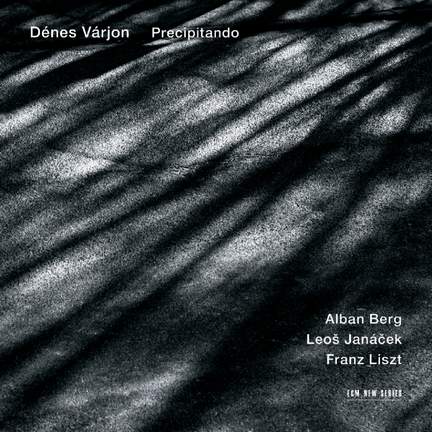
Dénes Várjon: Precipitando
Dénes Várjon (piano)
Awards:
-
BBC Music Magazine, April 2012, Instrumental Choice

the luminous playing of the opening of Berg's Sonata Op. 1 tells us this is a pianist of rare sensitivity...Varjon's probing approach reveals the finest shades of harmonic colouring and places...
Dénes Várjon: Precipitando
Dénes Várjon (piano)
Purchase product
Awards:
-
BBC Music Magazine, April 2012, Instrumental Choice
the luminous playing of the opening of Berg's Sonata Op. 1 tells us this is a pianist of rare sensitivity...Varjon's probing approach reveals the finest shades of harmonic colouring and places...
About
After important contributions to the album ‘Romancendres’, pairing the music of Clara Schumann and Heinz Holliger, and an acclaimed recording with Carolin Widmann of Schumann’s Violin Sonatas, here is the first ECM New Series solo disc from Hungarian pianist Dénes Várjon. It’s an unusual repertoire for a recorded recital – of three masterworks of piano literature by Berg, Janáček and Liszt.
The recital draws the listener in from the first moments – beginning with the dark, brooding language of Alban’s Berg’s Piano Sonata Op. 1, shaped in the shadow of Schoenberg, and continuing into the nebulous regions of Janáček’s impressionistic and near-contemporaneous In The Mists, finally emerging into the clear light of Liszt’s immense - and immensely-influential - B minor Sonata. In fact both Berg and Janáček were inspired by Liszt.
As Dénes Várjon says, “It is always highly interesting to find connections between composers, and bridges between epochs in musical history. In the mirror of other composers and periods, I begin to see new dimensions of works which I have performed, and this is especially the case when I play pieces by Ferenc Liszt. Even more strongly, I see him as a main figure of the current of music history. There are certain works by him I need to play and explore again and again - most importantly, his B minor Sonata. For all its rich texture, its great structure and its length, there is not one single note which is not a most important part of the whole.”
Dénes Várjon studied at the Ferenc Liszt Academy of Music in Budapest with, amongst others, composer György Kurtág. He is a regular guest at festivals including Edinburgh, Salzburg, Lucerne, Schleswig-Holstein, Venice, and the Marlboro Festival (USA). He is invited annually to András Schiff’s and Heinz Holliger’s Ittinger Konzerttage. He has performed with major orchestras such as The Camerata Salzburg, Academy of St. Martin in the Fields, Wiener Kammerorchester, Camerata Bern, Hungarian State Symphony Orchestra, the RSO Berlin, Scottish Chamber Orchestra, Chamber Orchestra of Europe, Gidon Kremer’s Kremerata Baltica, and many others.
Contents and tracklist
- Dénes Várjon (piano)
- Recorded: 2011-04-28
- Recording Venue: RSI Auditorium, Lugano
- Dénes Várjon (piano)
- Recorded: 2011-04-28
- Recording Venue: RSI Auditorium, Lugano
- Dénes Várjon (piano)
- Recorded: 2011-04-28
- Recording Venue: RSI Auditorium, Lugano
Awards and reviews
-
BBC Music MagazineApril 2012Instrumental Choice
 April 2012
the luminous playing of the opening of Berg's Sonata Op. 1 tells us this is a pianist of rare sensitivity...Varjon's probing approach reveals the finest shades of harmonic colouring and places more emphasis on the work's preludial character than most accounts...All in all, a very impressive and intelligently planned programme.
 June 2012
there's nothing new, unusual, surprising or quirky about Varjon's interpretations...Varjon's phrasing of the main theme of the first movement of the Janacek perfectly captures the music's speech-like syntax
 24th February 2012
Várjon here attempts to uncover connections between composers, with specific reference to the influence Liszt had upon Berg and Janácek...Negotiating dynamic shifts of emphasis, Várjon displays that most valuable of gifts: the ability to play in a way which makes you listen anew to the familiar.
 19th February 2012
Despite the many accounts of Liszt's Sonata in B minor released in the 2011 anniversary year, this late addition demands attention for its grandeur, clarity and incisive virtuosity. Várjon makes rigorous sense of the work's episodic structure, showing powerful ease in the fugue but enjoying the rhapsodic nature of the rest.